
For any procurement or formulation professional, the moment you compare two methyl acetate offers, you face the same question: is this material actually good enough for my process? A single specification sheet rarely tells the whole story. As our pillar guide Что такое АЦЕТАТ МЕТИЛА? explains, this versatile ester solvent powers everything from automotive refinishing to semiconductor cleaning—but performance in each of those applications depends entirely on quality consistency.
This guide goes one level deeper than a typical spec table. It explains the seven parameters that define methyl acetate quality, how each one is tested, how to read and validate a Certificate of Analysis (COA), and how to match grade to application—with particular attention to coating chemical formulators, who are the single largest end-users of this solvent.
Why Methyl Acetate Quality Matters—Especially in Coatings
Methyl acetate (CAS 79-20-9) is prized as a fast-evaporating active solvent for nitrocellulose, cellulose esters, and a wide range of coating resins. That same fast-drying behavior, however, magnifies the consequences of any off-spec impurity. In a high-speed coating or printing line, even trace contamination is carried directly into the wet film and locked into the final finish.
Here is what poor quality does on a coating line specifically:
- Non-volatile residue leaves microscopic deposits behind after the solvent flashes off—the root cause of fish-eyes, craters, haze, and reduced gloss in clear and high-gloss finishes.
- Excess water triggers humidity blush in nitrocellulose lacquers and, in two-component polyurethane (2K PU) systems, reacts with isocyanate to generate CO₂, causing foaming, pinholes, and loss of crosslink density.
- Free acidity can catalyze resin hydrolysis, destabilize the formulation in storage, and corrode mixing and transfer equipment.
- High color (yellowing) carries straight through into light-colored and transparent topcoats, where it is immediately visible to the end customer.
In other words, for coatings buyers, quality evaluation is not a paperwork formality—it is direct protection of film performance, batch yield, and brand reputation. The same logic applies, with even tighter limits, to pharmaceutical and electronics-grade material.
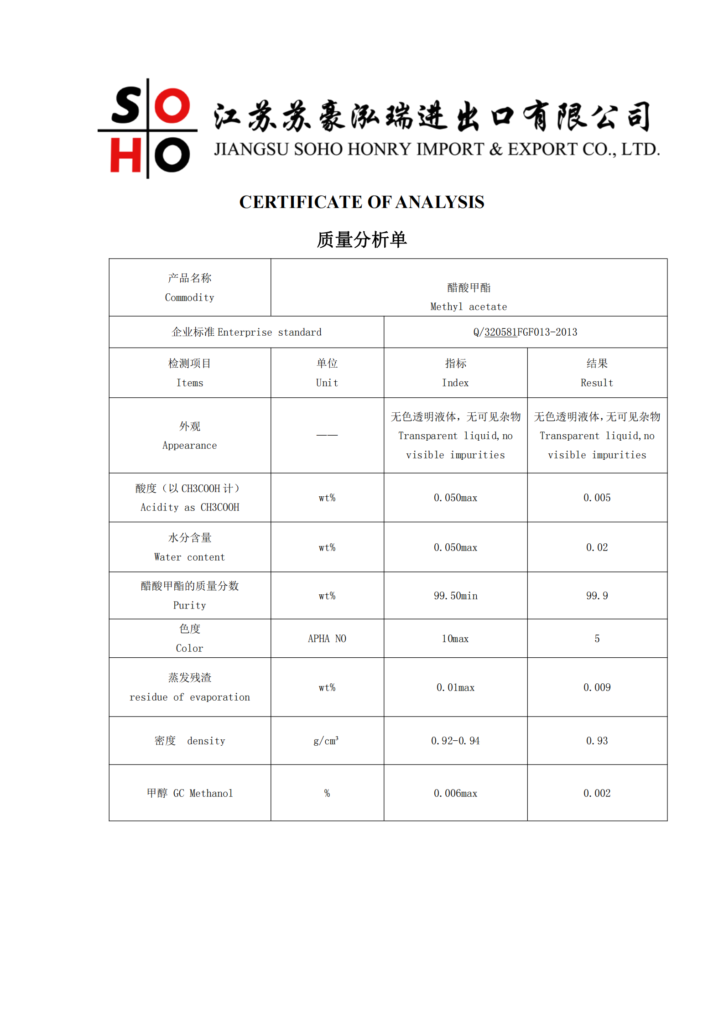
The 7 Core Quality Parameters and How They Are Tested
Reputable suppliers benchmark methyl acetate against an enterprise or national standard (for example, the Chinese enterprise standard family that sets purity at ≥99.50 wt%). The table below maps each parameter to the analytical method used to measure it—the part most spec sheets leave out.
| Parameter | Typical Requirement | Метод испытания | Why It Matters |
|---|---|---|---|
| Purity (assay) | ≥ 99.50 wt% (HP ≥ 99.9%) | Gas chromatography (GC), area normalization | Core performance and solvency indicator |
| Содержание воды | ≤ 0.05 wt% | Karl Fischer titration (ASTM E1064 / E203) | Reactivity, shelf life, blush/foaming risk |
| Acidity (as acetic acid) | ≤ 0.05 wt% | Acid–base titration with standardized NaOH | Equipment corrosion, formulation stability |
| Color (APHA / Pt-Co) | ≤ 10 | Platinum-cobalt comparison (ASTM D1209) | Yellowing in clear and light finishes |
| Residue on evaporation | ≤ 0.01 wt% | Gravimetric (ASTM D1353) | Surface defects, gloss, cleaning performance |
| Methanol content | ≤ 0.006% | Gas chromatography (GC) | Regulatory limit; alters evaporation profile |
| Density (20 °C) | 0.92–0.94 g/cm³ | Oscillating U-tube density meter / pycnometer (ASTM D4052) | Adulteration and contamination check |
A few practical notes on the methods themselves:
Gas chromatography is the backbone of purity and methanol analysis. Ask whether the supplier reports a full GC profile rather than a single assay number—the impurity peaks often reveal more than the headline purity figure.
Karl Fischer titration is the only reliable way to quantify trace water at the 0.0X% level; a simple “appears dry” visual check is meaningless for moisture-sensitive coating systems.
APHA (platinum-cobalt) color is a scale where lower is better. A result of 5 against a limit of 10 indicates the product has not undergone oxidative degradation and has been stored correctly.
Residue on evaporation is a deceptively important test for cleaning and high-gloss applications, because it directly predicts how much non-volatile matter the solvent will leave on a substrate.
How to Read and Validate a Certificate of Analysis (COA)
A COA is your primary quality document—but only if it is genuine and batch-specific. A complete, trustworthy COA should always contain:
- Product name and CAS number (79-20-9) with the grade clearly stated.
- A unique batch / lot number plus manufacture and test dates.
- Each parameter listed with its specification limit, the actual measured result, and the test method reference.
- An authorized signature or quality-control stamp.
COA Red Flags to Watch For
Experienced buyers learn to spot a weak or recycled COA quickly. Treat the following as warning signs:
- Identical “actual” values on every batch. Real testing produces small natural variation; a column of repeating numbers usually means the data was copied, not measured.
- Missing test methods. A result with no method behind it cannot be verified or reproduced.
- No batch number or test date, which makes the document untraceable to a specific shipment.
- Results sitting exactly on the spec limit for multiple parameters, which can indicate rounding to pass rather than genuine measurement.
- Refusal to provide third-party verification. A confident supplier should be willing to back its COA with an independent laboratory report.
This last point is where supplier capability becomes decisive. At SOHO Honry Chemical, batch-specific COA data is backed by an in-house R&D team able to issue testing reports against Eurofins and SGS standards, with factory certifications including FSSC, BRC, ISO, and GMP—exactly the kind of third-party validation that turns a COA from a claim into evidence.
Matching Quality Grade to Your Application
The most common—and most expensive—procurement mistake is buying the wrong grade: paying a premium for semiconductor-grade material destined for general cleaning, or, far worse, putting industrial-grade solvent into a pharmaceutical synthesis. Use the framework below to match grade to need.
| Класс | Typical Purity | Best Suited For |
|---|---|---|
| Industrial grade | 99.0–99.5% | General-purpose coatings, adhesives, degreasing and cleaning |
| High purity | ≥ 99.9% | Pharmaceutical synthesis, electronics and semiconductor cleaning, premium clear coatings |
| Food grade | ≥ 99.5% (with defined impurity limits) | Flavoring agents, food-contact packaging inks |
For coating chemical buyers, the decision usually sits between industrial and high-purity grade. Standard pigmented industrial and architectural coatings are well served by industrial grade. Move up to high purity when the finish is a high-gloss clear coat, an automotive topcoat, or a moisture-sensitive 2K PU system where residue and water content directly determine whether the film passes inspection. If you are formulating across several of these categories, explore the full range on our покровные химикаты page to align grade with each product line.
Common Quality Problems, Root Causes, and Impact
When incoming material disappoints, tracing the symptom back to its cause speeds up the supplier conversation. This table connects the three.
| Symptom | Likely Root Cause | Impact on Coatings |
|---|---|---|
| Elevated water content | Moisture ingress, poor drying, loose container seals | Blushing, foaming/pinholes in 2K PU, hydrolysis |
| High acidity | Hydrolysis during prolonged storage, incomplete neutralization | Equipment corrosion, reduced formulation stability |
| High APHA color | Oxidative degradation, metal contamination, aged stock | Yellowing of clear and light-colored finishes |
| High residue on evaporation | Contamination, non-volatile carryover from production | Fish-eyes, haze, gloss loss, cleaning failure |
| Methanol above limit | Incomplete purification or distillation | Altered evaporation rate, regulatory non-compliance |
| Off-spec density | Dilution, adulteration, or cross-contamination | Strong signal of an impure or tampered batch |
A pattern worth remembering: water, acidity, and color problems often originate not in production but in storage and transport. Methyl acetate should be kept in tightly sealed steel drums or IBCs, in a cool, ventilated area below 25 °C. A perfect production COA cannot protect material that has been stored badly for six months.
Supplier Due-Diligence Checklist
Quality is ultimately a supplier decision as much as a specification decision. Before committing to a methyl acetate source, confirm the following:
- ISO 9001 (or equivalent) quality-management certification.
- Batch-specific COA issued for every shipment, not a generic template.
- Third-party lab verification available on request (SGS, Eurofins, or equivalent).
- Current SDS compliant with GHS, plus correct UN 1231 / Class 3 transport documentation.
- Consistent batch-to-batch data and a willingness to provide retention samples.
- Regulatory documentation (REACH, country-of-origin) relevant to your import market.
A supplier that meets every item on this list de-risks not just one purchase but your entire downstream production schedule.
Incoming Inspection: Best Practices for Buyers
Even with a strong supplier, a short incoming-inspection routine protects your line:
- Inspect packaging on arrival—seals intact, containers undamaged, UN markings present.
- Take a representative sample (ideally drawing from top, middle, and bottom of a drum or IBC).
- Run a rapid verification panel: appearance and color, water by Karl Fischer, purity and methanol by GC, and density. These four checks catch the large majority of off-spec or adulterated material.
- Cross-check against the COA for that exact batch number.
- Retain a reference sample in a sealed container in case of a later dispute.
Часто задаваемые вопросы
What is the most important quality parameter for methyl acetate in coatings?
There is no single answer, but residue on evaporation and water content are usually the two that decide whether a coating film passes visual inspection. Residue drives surface defects and gloss, while water drives blushing and foaming in reactive systems.
Which test methods should a COA reference?
At minimum, gas chromatography for purity and methanol, Karl Fischer titration for water, acid–base titration for acidity, platinum-cobalt comparison for color, gravimetric analysis for residue, and a density meter for relative density.
How can I tell industrial grade from high-purity methyl acetate?
Purity is the headline difference—roughly 99.0–99.5% for industrial grade versus ≥99.9% for high purity—but the more meaningful distinction is the tightness of the impurity limits (methanol, water, residue), which is why high-purity grades command a premium in pharmaceutical and electronics use.
Can I rely on a supplier’s COA alone?
A genuine, batch-specific COA is a strong starting point, but best practice is to confirm it with a brief incoming-inspection panel and, for critical applications, an independent third-party report.
Does storage affect methyl acetate quality?
Yes. Water uptake, acidity, and color can all drift during prolonged or poor storage. Always check the manufacture date and storage history, not just the production COA.
Source Quality Methyl Acetate with Confidence
Evaluating methyl acetate quality comes down to three habits: read the full specification (including test methods, not just headline numbers), validate every COA against the batch in front of you, and choose a supplier that can prove its quality with third-party data.
To revisit the complete picture—applications, properties, production, market trends, and safety—return to the pillar guide Что такое АЦЕТАТ МЕТИЛА? or explore what methyl acetate is used for in detail.
Ready to request a batch-specific COA or a quotation? View our methyl acetate product page, review our certifications, или contact our team for technical and sourcing support.
