


| Core material Sodium carbonate (Na₂CO₃) |
Для Glass, chemical, detergent, and water-treatment teams |
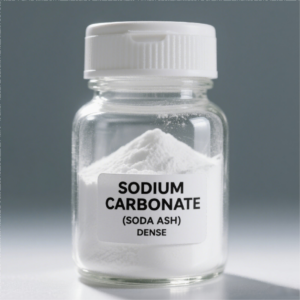
Soda ash dense is a high-bulk-density, granular form of sodium carbonate (Na₂CO₃), one of the chemical industry’s most widely used alkaline raw materials. It is supplied to glass manufacturers, detergent producers, chemical plants, water-treatment operations, pulp and paper mills, and metallurgical facilities. Although it has the same chemical identity as soda ash light, its larger particles and higher bulk density make it behave differently in storage, conveying, metering, and dissolution.
That distinction matters. A plant that needs low-dust, continuous dry feeding may benefit from dense soda ash. A process that must make a solution quickly may be better served by light soda ash. The right choice is therefore not simply a matter of purity or price per metric ton; it is a process decision that affects storage capacity, freight utilization, operator exposure, mixing time, equipment performance, and total operating cost.
This guide explains what soda ash dense is, where it is used, how it differs from soda ash light, and what buyers should verify before placing an order.
1. What Is Soda Ash?
Soda ash is the common industrial name for sodium carbonate, an inorganic compound with the formula Na₂CO₃. It is usually supplied as a white, odorless powder or granule and produces an alkaline solution when dissolved in water. In manufacturing, sodium carbonate is valued for three broad functions: it raises pH, contributes alkalinity, and takes part in reactions that produce other useful materials.
It is also an important flux in glass production. When incorporated into a silica-based glass batch, soda ash helps lower the temperature at which the batch melts. This supports efficient furnace operation and helps make large-scale glass production practical. For that reason, glass is one of the most important end uses of soda ash worldwide.
Soda ash should not be confused with baking soda. Baking soda is sodium bicarbonate, NaHCO₃, and it has different chemical behavior. Sodium bicarbonate is commonly used in foods and household applications, while sodium carbonate is the stronger alkaline material more commonly used as an industrial process chemical. Search terms such as “sodium carbon” are sometimes used informally, but sodium carbonate is the accurate chemical name for soda ash.
Commercial soda ash can be produced by synthetic routes, including the Solvay process, or recovered from natural trona ore. The production route can affect a supplier’s process description and environmental profile, but a buyer should still evaluate the finished grade by its actual specification: sodium carbonate assay, particle size, bulk density, moisture, insolubles, and relevant impurities.
2. What Is Soda Ash Dense?
Soda ash dense, also called dense soda ash or heavy soda ash, is the granular, high-density grade of sodium carbonate. It is not a different chemical compound. Both dense and light grades are principally Na₂CO₃. The difference is physical: dense soda ash consists of coarser, more compact particles, while light soda ash is a fine, lower-density powder.
Typical dense soda ash has a bulk density around 1.00 to 1.10 g/cm³, while light soda ash is often around 0.50 to 0.60 g/cm³. Exact values vary by producer and grade, so a current technical data sheet and certificate of analysis should always control a purchase decision. The practical implication is straightforward: dense soda ash packs more mass into the same vessel, bag, container, truck, or silo volume.
The coarse granular form also tends to flow more consistently through hoppers, screw conveyors, enclosed transfer lines, and loss-in-weight feeders. It generally generates less airborne dust than a fine powder during transfer. These advantages make it attractive for large-volume, automated dry handling. Its tradeoff is dissolution speed: because the particles have less exposed surface area per kilogram, dense soda ash normally dissolves more slowly than soda ash light under comparable mixing conditions.
3. Soda Ash Dense vs. Soda Ash Light
Dense and light soda ash are often discussed as if one were a premium chemical grade and the other a lower-quality product. That is not the right comparison. Their suitability depends on the application.
| Свойство | Soda Ash Dense | Soda Ash Light |
| Main chemical | Sodium carbonate, Na₂CO₃ | Sodium carbonate, Na₂CO₃ |
| Physical form | Coarse, compact granules | Тонкий порошок |
| Typical bulk density | About 1.00–1.10 g/cm³ | About 0.50–0.60 g/cm³ |
| Dry-flow behavior | Usually stable and free-flowing | More sensitive to dust, humidity, and bridging |
| Dust generation | Relatively lower | Relatively higher |
| Dissolution | Usually slower | Usually faster |
| Best fit | Bulk handling and continuous dry feed | Quick solution preparation and wet processing |
Bulk density, storage, and freight
Dense soda ash allows more product to fit into a fixed volume. This can improve silo utilization and reduce the storage footprint needed for a given inventory. It can also improve load utilization in containers and trucks, which may be important for long-distance shipments or sites with limited warehouse capacity. The final freight benefit depends on the applicable payload limit, container type, route, packaging, and the customer’s unloading arrangement, but bulk density should be part of every logistics calculation.
Flow, dust, and metering
Fine powders can become airborne more easily at bag-dumping stations, conveyor transfer points, and open charging locations. They can also be more prone to moisture-related caking or bridging if storage conditions are poor. Dense granules usually reduce these challenges, especially when a process relies on enclosed mechanical or pneumatic conveying and stable continuous dosing.
That does not remove the need for good engineering. Both grades need dry storage, suitable hopper geometry, compatible feeders, and appropriate dust control. A dense grade should be selected against the equipment’s particle-size range, feed-rate requirement, and material-transfer distance rather than on a general assumption that “granules always flow.”
Dissolution and reaction speed
Light soda ash has a larger surface area and generally disperses and dissolves more quickly in water. This can be useful in solution tanks, detergent slurries, textile dye baths, and chemical reactors. Dense soda ash can still dissolve in water, but it may require more time, stronger agitation, a different feed point, or a purpose-designed dissolution system.
For applications with a rapid pH-response requirement, a plant should test the solution-making cycle with the proposed grade. Conversely, a process that uses dry addition or does not need immediate dissolution may gain more from the handling benefits of dense soda ash.
4. Main Uses of Soda Ash Dense
4.1 Glass manufacturing
Glass manufacturing is one of the most important uses of soda ash dense. Sodium carbonate is included in glass batch formulations as a flux, helping silica-rich raw materials melt at a lower temperature than silica alone. This contributes to controlled melting and supports efficient production of flat glass, container glass, fiberglass, automotive glass, architectural glass, and specialty glass.
Large glass plants commonly operate continuous batch systems with high material throughput. Dense soda ash fits these systems well because its bulk density supports efficient silo storage and its granular form is well suited to conveyors, weigh feeders, and automated batching equipment. Lower dust generation during transfer can also help housekeeping and collection systems, although site-specific controls remain necessary.
For glass applications, the required specification is not limited to sodium carbonate content. Buyers should verify particle size, bulk density, moisture, and impurities that may affect glass color, melting behavior, or batch consistency. The appropriate limits are determined by the specific glass formulation and process.
4.2 Detergents and dry cleaning formulations
Sodium carbonate is widely used in laundry detergents, dishwasher powders, industrial cleaners, and water-softening formulations. It contributes alkalinity and can help reduce the effect of calcium and magnesium ions in hard water. In an appropriately designed detergent system, this can support soil removal and allow surfactants to perform more effectively.
Dense soda ash is often convenient for powdered products and dry blending lines because it can be stored, transferred, and metered with relatively low dust. It may be a good match for plants that use bulk bags, automated weighing, continuous mixers, and dry packaging equipment. However, the grade should be chosen in the context of the entire formulation. If a manufacturer first produces a concentrated solution or slurry, light soda ash may offer faster mixing and shorter solution-preparation time.
4.3 Chemical manufacturing and intermediate production
Dense soda ash serves as a basic feedstock in the manufacture of many sodium-based products and chemical intermediates. Examples can include sodium silicate, sodium bicarbonate, selected borate-related materials, and other inorganic compounds. In these processes, consistent feed rate and reliable material handling can be just as important as chemical assay.
Because dense soda ash is compact and granular, it can be used in bulk silo systems, enclosed conveyors, screw feeders, and gravimetric dosing equipment. These properties can support stable raw-material addition to continuous or semi-continuous production systems. Where the reaction requires a solution rather than a dry addition, the plant should define the required dissolution time and validate the mixing arrangement before converting grades.
4.4 Water and wastewater treatment
Water-treatment operators use sodium carbonate to raise pH, neutralize acidic streams, and assist with hardness control. Relevant applications may include municipal water treatment, industrial process water, wastewater neutralization, cooling-water systems, boiler-water preparation, and mineral-processing water.
Dense soda ash can be well suited to controlled dry-feed systems. Its low-dust handling characteristics can be useful in facilities that receive material in bulk or super sacks and convey it to a hopper or feed system. But water-treatment chemistry must always be managed by testing and calculation. The required dosage depends on influent flow, alkalinity, hardness, acidity, target pH, competing ions, and discharge or product-water requirements.
No grade should be selected solely because the application is called “water treatment.” A plant that needs a stable dry feed may favor dense soda ash, while one that needs to make a solution quickly to respond to changing water quality may favor light soda ash or a carefully designed dissolution system.
4.5 Pulp and paper processing
In pulp and paper operations, sodium carbonate can support alkaline process conditions, chemical recovery activities, and the neutralization of acidic streams. Stable alkalinity can help maintain consistent processing conditions in areas such as pulp washing, bleaching support, wastewater treatment, and recovery-related operations.
Dense soda ash is particularly relevant where large volumes are moved through dry handling equipment. The grade can offer practical benefits in storage density, controlled feeding, and reduced dust during transfer. Specific use and dosage must be aligned with the mill’s pulping chemistry, effluent requirements, quality objectives, and existing recovery system.
4.6 Metallurgy and mineral processing
Soda ash can be used as an alkaline material or fluxing component in selected metallurgical and mineral-processing operations. Depending on the process, it may contribute to melt behavior, impurity treatment, ore preparation, or pH adjustment in mineral-processing circuits. Applications can occur in steel-related operations, nonferrous processing, refining, and ore treatment.
The exact role of sodium carbonate varies widely by feed material and process design, so buyers should not generalize a dosage or performance claim from one metal system to another. Dense soda ash is attractive where a facility benefits from bulk storage, steady dry addition, and compact logistics.
5. When Should You Choose Dense Soda Ash?
Dense soda ash should be a leading option when handling efficiency is more important than immediate dissolution. It is commonly worth evaluating in the following situations:
- A plant uses silos, hoppers, automatic weigh feeders, screw conveyors, or enclosed pneumatic conveying.
- Continuous dry dosing and stable mass flow are important to product quality or process control.
- The facility wants to reduce dust at transfer points and bag-dumping areas.
- Warehouse or silo capacity is limited and higher mass per unit volume is valuable.
- The material will be shipped over a long distance and container or truck utilization matters.
- The application is a high-throughput dry process such as glass batching, bulk chemical feed, or dry detergent blending.
Dense soda ash may not be the best default choice where rapid solution preparation is critical. Light soda ash is often a stronger candidate for liquid detergent production, textile dyeing, quick pH correction in solution systems, slurry preparation, and wet-process reactors. In some cases, a dense grade can still be used successfully after adjusting agitation, solution temperature, residence time, or feed design. A small-scale trial is the safest way to confirm performance.
6. How to Select the Right Grade for Your Process
The most useful selection process starts with operating conditions rather than with a product name. Ask the following questions before requesting a quotation:
- **How quickly must the soda ash dissolve?** Define an acceptable solution-preparation time and confirm it under representative water quality and agitation conditions.
- **Is the process dry feed or wet processing?** Dry, continuous systems often favor dense soda ash; solution and slurry systems may favor light soda ash.
- **What equipment is already installed?** Review hopper geometry, feeder type, dust collection, transfer distance, available mixing power, and storage volume.
- **What quality limits does the downstream product require?** Specify sodium carbonate assay, particle-size range, bulk density, moisture, insolubles, chloride, iron, sulfate, and other impurities as relevant.
- **What regulatory or customer requirements apply?** Food, pharmaceutical, and drinking-water-related uses may require a certified grade and additional documentation.
- **What is the total delivered and processing cost?** Include freight, storage, packaging, labor, dust control, equipment changes, waste, cleaning, and downtime—not only the price per ton.
This approach avoids the common mistake of treating two physically different grades as interchangeable. It also gives suppliers the information needed to recommend a grade and packaging format that actually fits the plant.
7. Buying Soda Ash Dense: Documents and Specifications to Request
A reliable purchase decision needs evidence, not only a sales description. Ask the supplier for a current technical data sheet that clearly identifies the supplied dense grade. At minimum, request:
- Sodium carbonate content or assay;
- Bulk density range;
- Particle-size distribution;
- Moisture content;
- Water-insoluble matter;
- Relevant chloride, iron, sulfate, or other impurity limits;
- Certificate of analysis (COA) linked to the shipment batch;
- Safety data sheet (SDS);
- Packaging details, net weight, palletization, and moisture-protection method;
- Production route, origin, lead time, loading point, and delivery terms where relevant.
For regulated applications, a standard industrial COA may not be enough. Food, pharmaceutical, or drinking-water uses can require a specific grade, traceability, test methods, compliance statements, and third-party certifications. An industrial product should never be substituted automatically just because its chemical name is the same.
Packaging should also be matched to the operating model. Common formats include small bags for manual use, 25 kg bags for regular industrial consumption, flexible intermediate bulk containers (FIBCs or super sacks) for forklift-based operations, and bulk delivery to silos for high-volume plants. A buyer should confirm how the product will remain dry during loading, ocean or road transit, warehouse storage, and unloading.
For product specifications, packaging options, and supply discussions, visit https://www.honrychemical.com/. Final purchasing decisions should be based on the latest technical documents, commercial terms, and a grade trial under actual operating conditions.
8. Storage, Handling, and Worker Safety
Dense soda ash is easier to handle than a fine powder in many systems, but it is still moisture-sensitive and must be managed carefully. Keep bags or bulk containers closed until use and store them in a dry, covered, ventilated location. Place packaged material on pallets, protect it from wet floors, roof leaks, condensation, and direct weather exposure, and use first-in, first-out inventory control.
Regular inspections should look for damaged packaging, caking, contamination, or blocked outlets. In a bulk system, check that the silo, hopper, feeder, and transfer equipment are appropriate for the product’s particle size and required feed rate. Enclosed transfer points and local dust collection can reduce airborne particles and improve work-area cleanliness.
Sodium carbonate is generally nonflammable, but dust can irritate eyes, skin, and the respiratory tract. Workers should follow the applicable SDS and site procedures. Typical controls may include safety glasses or chemical splash goggles, gloves, protective clothing, closed footwear, suitable respiratory protection where dust remains present, accessible eyewash equipment, ventilation, and prompt cleanup of spills. Avoid cleanup methods that unnecessarily put dry dust back into the air.
9. Sustainability and Environmental Considerations
Soda ash can support environmental applications, especially pH adjustment and acidic wastewater neutralization. In selected systems, it can help operators maintain a water chemistry range that protects equipment and supports downstream treatment. It can also be used in certain gas-cleaning or sulfur-control processes, depending on the plant design and reaction conditions.
However, soda ash should not automatically be described as “green.” Its overall environmental profile depends on the production route, energy source, water use, transport distance, packaging, waste management, and application efficiency. Buyers who need sustainability information should ask suppliers about origin, production method, energy and water practices, emissions reporting, environmental management systems, and packaging options.
Dense soda ash may offer a logistics advantage because more material fits into a given volume. Better load utilization can reduce the number of loads or containers required in some supply chains. The actual benefit must be calculated for the route and packaging configuration; it is an operational possibility, not a universal claim.
10. Common Mistakes to Avoid
**Assuming dense and light grades are chemically different.** Both are primarily sodium carbonate. The choice should focus on physical behavior and process fit.
**Buying only on the lowest quoted price.** A lower material price can be offset by higher freight, storage, labor, dust-control, cleaning, or downtime costs. Compare total cost of ownership.
**Ignoring dissolution requirements.** Dense soda ash can be a poor match for an application that needs a solution immediately. Confirm solution performance before full-scale use.
**Ignoring moisture and dust control.** Even dense granules can cake in poor storage conditions. Good packaging, dry storage, suitable equipment, and dust controls remain essential.
**Using an uncertified grade in a regulated application.** Food, pharmaceutical, and water-related uses may require product-specific compliance documentation. Verify the exact grade and batch paperwork before purchase.
**Skipping a plant trial.** A short trial can reveal flow, feeder accuracy, dissolution time, dust, packaging, and compatibility issues before a full production commitment.
Часто задаваемые вопросы
Is soda ash dense the same as sodium carbonate?
Yes. Soda ash dense is a granular, high-bulk-density form of sodium carbonate (Na₂CO₃). “Dense” describes its physical form and handling behavior, not a different chemical formula.
What is the difference between soda ash dense and soda ash light?
Both grades are primarily sodium carbonate. Dense soda ash has coarser particles, higher bulk density, better dry-flow behavior, and lower dust generation. Light soda ash is a finer powder that generally dissolves faster. The best grade depends on whether a process prioritizes dry handling or rapid solution preparation.
Is soda ash dense used for glass manufacturing?
Yes. Dense soda ash is widely used in flat glass, container glass, fiberglass, automotive glass, and architectural glass production. It acts as a flux in the batch and is well suited to the continuous bulk-handling systems commonly used by glass plants.
Can soda ash dense be used in water treatment?
Yes. It can be used to raise pH, neutralize acidic streams, and assist with hardness control. The correct dosage and grade selection depend on the water chemistry, feed system, target water quality, and applicable regulations. Water should be tested rather than treated using a fixed generic dosage.
Does dense soda ash dissolve in water?
Yes, but it normally dissolves more slowly than light soda ash because its particles are larger. If rapid dissolution is essential, test the proposed dense grade with the actual water quality, mixing power, temperature, and residence time, or consider light soda ash.
Is soda ash the same as baking soda?
No. Soda ash is sodium carbonate (Na₂CO₃); baking soda is sodium bicarbonate (NaHCO₃). They have different chemical properties and are not automatically interchangeable in industrial, food, or household applications.
How should soda ash dense be stored?
Store it in a dry, covered, ventilated area and keep packages sealed until use. Protect bags or bulk containers from rain, condensation, wet floors, and contamination. Use pallets, inspect stock for moisture damage or caking, and follow first-in, first-out inventory practices.
What documents should a soda ash dense supplier provide?
At minimum, request a current technical data sheet, a batch-specific COA, and an SDS. The documents should identify the sodium carbonate assay, bulk density, particle-size distribution, moisture, insolubles, relevant impurity limits, packaging, and safety requirements. Regulated applications may need additional certification and traceability records.
Заключение
Soda ash dense is a granular, high-bulk-density form of sodium carbonate designed for efficient industrial handling. Its most important advantages are compact storage, effective bulk transport, stable dry feeding, and relatively low dust during transfer. These characteristics make it particularly useful in glass manufacturing, dry detergent production, chemical processing, water treatment, pulp and paper operations, and selected metallurgical applications.
The dense grade is not automatically better than soda ash light. It is better when a process values dry-flow performance, automated handling, and logistics efficiency. Light soda ash is often better when quick dissolution, slurry preparation, or wet-process mixing is the priority. The strongest purchase decision combines a clear process requirement, complete technical documentation, total-cost analysis, and a practical test of the proposed grade.
To discuss dense soda ash specifications, packaging, and supply options, please Свяжитесь с нами.
