

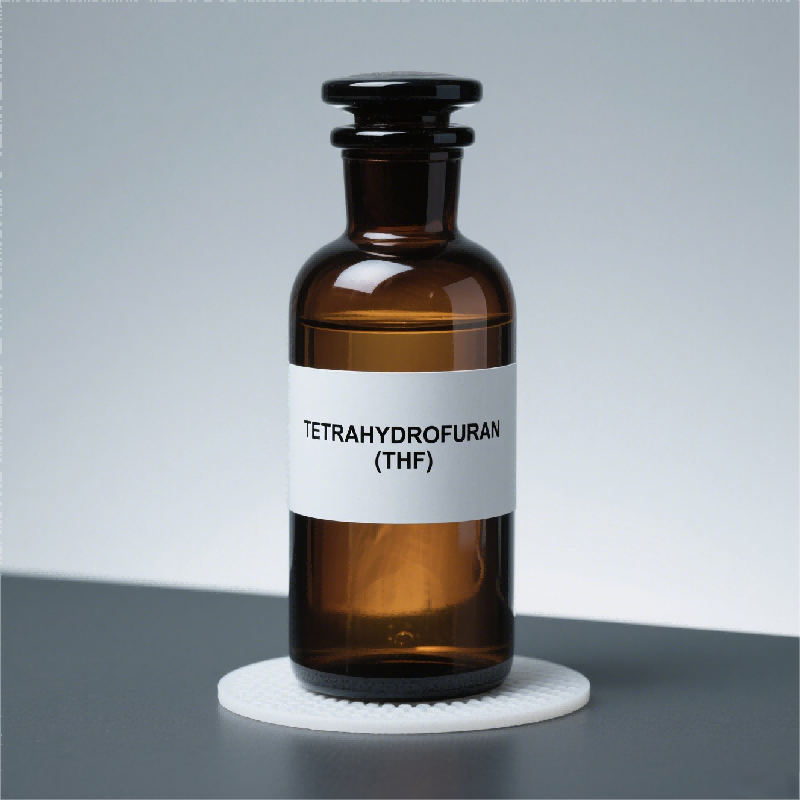
Tetrahydrofuran (THF), with the molecular formula C₄H₈O, is a cyclic ether characterized by a five-membered ring consisting of four carbon atoms and one oxygen atom. This structure imparts THF with unique solvent properties, including high polarity and low viscosity. It is a colorless, water-miscible liquid with an ether-like odor.
-
CAS Number: 109-99-9
-
Molecular Weight: 72.11 g/mol
-
Boiling Point: 66°C
-
Melting Point: -108.4°C
-
Density: 0.89 g/cm³ at 20°C
-
Flash Point: -17°C (highly flammable)
-
Solubility: Miscible with water, alcohols, acetone, and diethyl ether
-
Dielectric Constant: 7.6 at 22°C
Due to its high polarity and ability to dissolve a wide range of substances, THF is classified as a moderate polar aprotic solvent. It is also a Lewis base, capable of coordinating with various Lewis acids.
Applications
1. Polymer and Resin Industry
-
Polyurethane Production: THF is a key precursor in the synthesis of poly(tetramethylene ether) glycol (PTMEG), which is used to produce spandex fibers and thermoplastic polyurethanes.
-
Polyvinyl Chloride (PVC) Processing: Acts as a solvent for PVC, facilitating its processing and application in adhesives and coatings.
-
Polymeric Materials: Used in the production of various polymeric materials, including adhesives and sealants.
2. Coatings and Inks
-
Surface Coatings: THF is utilized as a solvent in surface coatings, providing desired properties such as quick drying and good adhesion.
-
Printing Inks: Employed in the formulation of printing inks, especially in applications requiring rapid evaporation rates.
-
Magnetic Tapes and Film Coatings: Used in the production of magnetic tapes and film coatings, contributing to the uniformity and quality of the final product.
3. Electroplating:In aluminum electroplating processes, THF serves as a solvent that allows precise control over the thickness and brightness of the aluminum layer, enhancing the quality of the electroplated surface.
4. Pharmaceutical Industry
-
Drug Synthesis: THF is employed in the synthesis of various pharmaceuticals, including carbetaquinine, rifamycin, and progesterone.
-
Solvent in Pharmaceutical Preparations: Used as a solvent in the preparation of pharmaceutical formulations, aiding in the dissolution and delivery of active ingredients.
5. Chemical Synthesis
-
Organic Reactions: THF is utilized as a solvent in various organic reactions, including Grignard and lithium-based reactions, due to its ability to stabilize reactive intermediates.
-
Borane Complexes: THF forms complexes with borane, such as borane–tetrahydrofuran, which are used in selective reductions and hydroboration reactions.
6. Odorant Production:When treated with hydrogen sulfide, THF produces tetrahydrothiophenol, which is used as an odorant (identification additive) in fuel gas.
Safety and Handling
- Flammability: THF is highly flammable; appropriate precautions should be taken to prevent ignition sources.
- Peroxide Formation: THF can form explosive peroxides upon exposure to air; stabilizers such as butylated hydroxytoluene (BHT) are often added to prevent peroxide formation.
- Storage: Store in tightly sealed containers, away from heat and sources of ignition, in a cool, dry place.
- Personal Protective Equipment (PPE): Use appropriate PPE, including gloves, goggles, and protective clothing, when handling THF.
Packaging and Availability
THF is available in various grades, including anhydrous and stabilized forms, and is supplied in different packaging options to suit customer needs. It is widely available through chemical supply distributors and can be sourced globally.
Certificates



Payment terms: Various payment methods are available, including T/T IN ADVANCE, Part repayment and part credit, etc.
