


For most teams, ACETATO DE METILO (CAS 79-20-9) is a line item in a bill of materials — until the day the price moves, a grade goes on allocation, or a regulator reclassifies a competing solvent. Market intelligence is what turns that line item into a planned, defensible procurement decision: when to lock a contract, which purity to specify, where to source, and how much supply risk to carry.
This guide is written for procurement managers, sourcing professionals, and formulators who already understand the chemistry. (If you need the technical foundation first, see our overview of what METHYL ACETATE is.) Below, we break down the 2025–2035 market — size and forecast, demand by application, the shift toward high purity, regional dynamics, drivers and risks, the competitive landscape, and, most importantly, what each trend means for your buying strategy.
METHYL ACETATE Market Size & Forecast at a Glance (2024–2035)
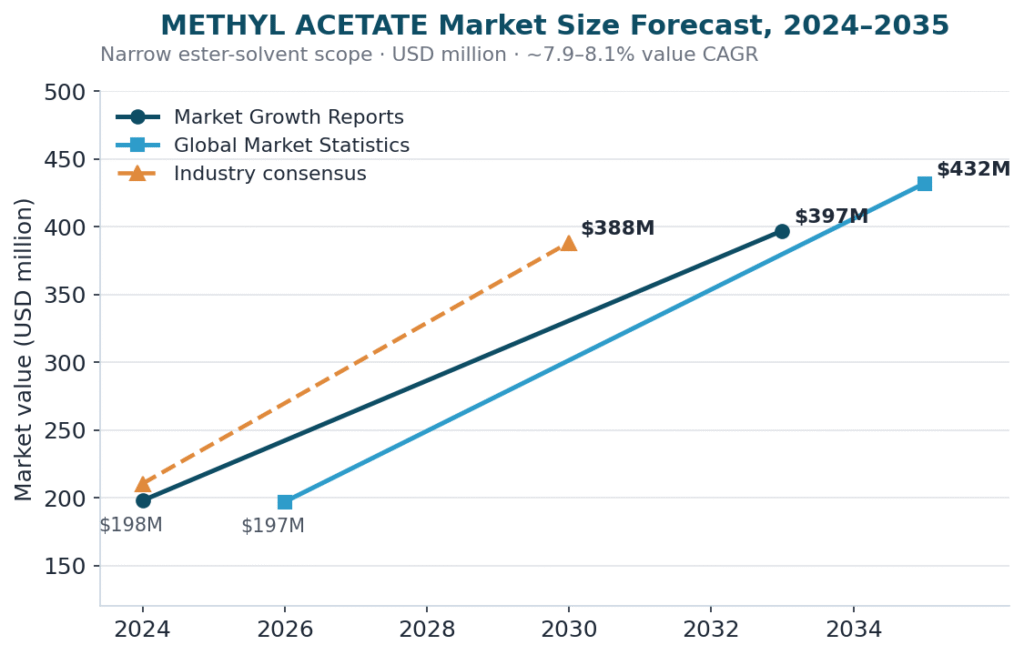
There is no single “correct” number for the ACETATO DE METILO market, and any buyer who has compared two research reports knows it. Estimates diverge widely depending on how each analyst defines the market. The table below reconciles four of the most cited views.
| Fuente | Base value | Forecast value | CAGR | Scope |
|---|---|---|---|---|
| Global Market Statistics | ~USD 197 M (2026) | ~USD 432 M (2035) | 8.1% | Narrow — ester solvent itself |
| Market Growth Reports | ~USD 198 M (2024) | ~USD 397 M (2033) | 8.1% | Narrow — ester solvent itself |
| Industry consensus (incl. our pillar data) | ~USD 210 M (2024) | ~USD 389 M (2030) | 7.9% | Narrow — ester solvent itself |
| Market Research Future | ~USD 7.0 B (2024) | ~USD 10.3 B (2035) | 3.57% | Broad — wider derivative/value chain |
Why the numbers disagree. Three of the four estimates cluster tightly around a few hundred million US dollars and a high-single-digit growth rate. The outlier in the billions reflects a much broader market definition that captures a wider slice of the downstream value chain. Neither is “wrong” — they answer different questions. For a buyer evaluating solvent contracts, the narrow definition is the relevant one.
Value vs. volume — the detail that matters most. Market Growth Reports estimates global volume at roughly 1,925 KMT in 2024, growing toward about 2,877 KMT by 2034 — a volume CAGR near 4%. Set that against the ~8% value CAGR and a clear signal emerges: value is growing roughly twice as fast as tonnage. That gap is the market re-mixing toward higher-purity, higher-priced grades. For procurement, it implies that the average price per ton is trending up over the decade, even before raw-material inflation is considered.
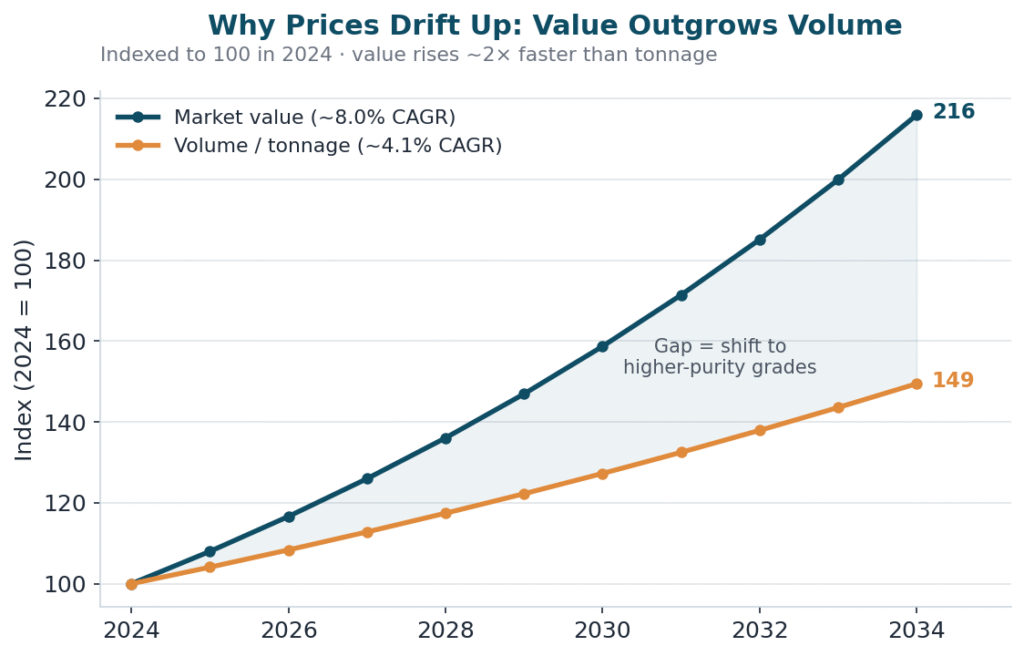
Buyer takeaway: Don’t anchor your planning to a single headline figure. Track the direction — mid-to-high single-digit value growth, slower volume growth, and a steady premium shift toward high purity — and apply it to your specific application segment.
Demand by Application — Where the Growth Is
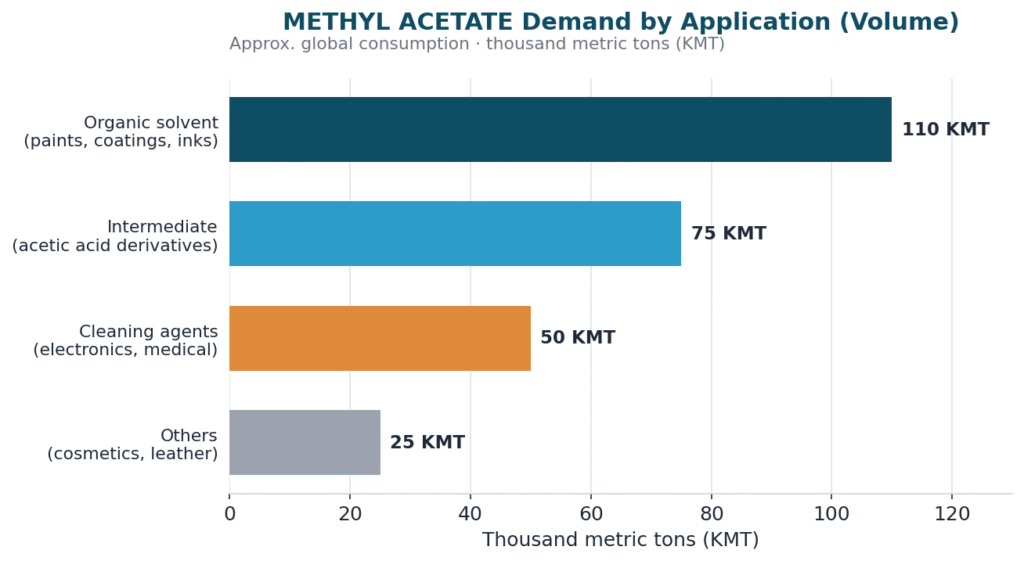
Paints, Coatings & Wood Finishes (largest)
Coatings remain the anchor end-use for ACETATO DE METILO, valued for fast evaporation, clean film formation, and strong solvency for nitrocellulose and cellulose esters. Automotive refinishing, industrial coatings, and wood finishes drive steady baseline demand. Buyer note: industrial grade (99.0–99.5%) is generally sufficient here, so cost and supply reliability matter more than ultra-high purity.
Adhesives & Sealants (fast-growing)
Analysts repeatedly flag adhesives and sealants as one of the fastest-growing applications, tied to construction, packaging, and automotive assembly. Rapid set times and good resin dissolution make the solvent attractive in high-throughput manufacturing.
Electronics & Precision Cleaning (high-purity, high-margin)
Demand for ultra-high-purity (≥99.9%) material is rising alongside semiconductor capacity expansion, where it is used for PCB and component cleaning and in photoresist-related processing. This is a smaller-volume but premium, fast-growing pocket of the market — and the one most exposed to supply tightness.
Pharmaceutical & Chemical Intermediates
As an intermediate and process solvent, ACETATO DE METILO feeds API synthesis and specialty chemical production. Multiple reports name pharmaceutical grade as the fastest-growing grade segment, driven by an expanding generics pipeline and tighter purity requirements.
Packaging & Flexographic Inks
E-commerce growth continues to pull flexographic printing-ink demand, where low odor and fast drying suit high-speed, food-adjacent packaging lines.
For a deeper breakdown of each end-use, see our companion guide on what METHYL ACETATE is used for.
Purity & Grade Trends — The Shift Toward High Purity
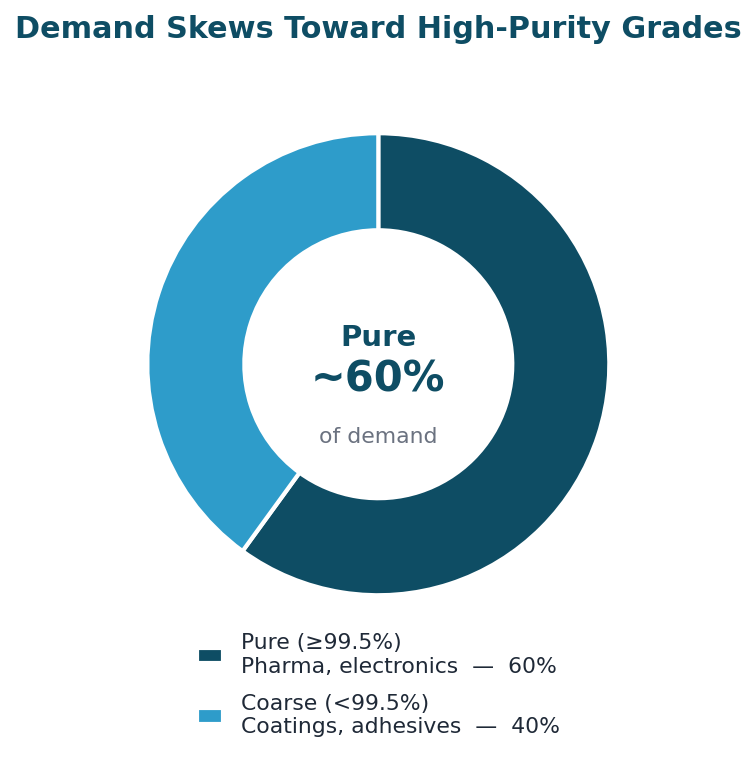
The market is segmenting sharply by purity. The 99.5%-and-above tier holds the largest share, while the 99.0–99.49% band is among the fastest-growing — and high-purity “pure” grade is estimated to account for roughly 60% of total demand. On the grade axis, technical grade still leads by volume, but pharmaceutical grade is expanding fastest.
Buyer takeaway: This is the single most actionable trend for sourcing. High-purity and pharma-grade supply is structurally tightening as electronics and pharma demand grows. If you buy into those segments, secure capacity earlier in the year, build longer lead times into your plan, and make COA verification non-negotiable — confirm purity, water content, acidity, methanol content, and APHA color on every batch. Matching grade precisely to application (rather than over-specifying) is also a direct cost lever. See the grade and quality criteria on our METHYL ACETATE product page.
Regional Market Dynamics 2025–2035
Asia-Pacific
Asia-Pacific is the center of gravity for supply. China alone is commonly cited at around 55% of the global market and Asia-Pacific at over 60% of volume. A major structural reason: large quantities of ACETATO DE METILO arise as a co-product of purified terephthalic acid (PTA) manufacturing, which is concentrated in the region. Industrialization and urbanization in China, India, and Southeast Asia also make APAC the fastest-growing demand region.
North America
North America is a high-value consumption market, supported by a regulatory tailwind: the solvent’s VOC-exempt status under U.S. EPA rules favors it over alternatives such as toluene. Broad-scope analyses that weight higher-value grades sometimes rank North America as the largest market by value — a reminder that “largest by volume” (APAC) and “largest by value” can differ.
Europe
Europe’s demand is shaped by REACH and a sustained push toward low-VOC and bio-based solvents, with Germany, France, and the Netherlands as leading consumers.
Middle East, Africa & Latin America
Smaller today but emerging, with growth tied to construction and automotive activity as economies industrialize and diversify.
Buyer takeaway: “Where demand grows” is not the same as “where it is cheapest to source.” APAC offers the deepest, most cost-competitive supply base, but landed cost, lead time, trade duties, and Class 3 dangerous-goods logistics can erode that advantage. Weigh ex-works price against total landed cost and supply security for your region.
Key Market Drivers (2025–2035)
- The green-solvent shift. Tightening VOC and HAP regulation is steadily pushing formulators away from legacy solvents. The VOC-exempt designation is a durable, regulation-backed advantage that supports demand through the forecast period.
- E-commerce packaging and flexo inks. Sustained parcel-volume growth keeps pulling printing-ink demand.
- Electronics and semiconductors. New fab capacity adds structural demand for ultra-high-purity grades.
- Pharmaceutical API synthesis. A growing generics and specialty pipeline lifts pharma-grade consumption.
- APAC urbanization and PU foam. Furniture, bedding, and insulation demand supports use as a blowing agent.
- Bio-based emergence. Producers are investing in greener routes — Eastman has moved on bio-based capacity, and India’s Alpha Chemika announced a bio-based expansion using enzymatic catalysis in 2025. Over the decade, bio-based options may become a procurement criterion in sustainability-led tenders.
Restraints, Risks & Challenges Buyers Should Watch
- Feedstock price volatility. Methanol and acetic acid prices drive production cost; methanol has swung roughly between USD 350–450 per ton in recent periods, and that volatility passes through to solvent pricing.
- Supply-chain disruption. Concentrated production and feedstock flows (including Middle East energy and petrochemical routes) leave the market exposed to logistics shocks and rerouting.
- Substitute pressure. Ethyl acetate, acetone, and increasingly dimethyl carbonate and ethyl lactate compete on cost, familiarity, or environmental profile. Substitution risk caps how much price premium the market will bear.
- EHS and flammability regulation. As a highly flammable (GHS Category 1) liquid, it carries storage, transport, and compliance costs that may rise as rules tighten.
Buyer takeaway: Build these into commercial terms — consider index-linked or hedged pricing around the methanol cycle, qualify a second source (ideally in a different region) for supply security, and keep an approved-alternate solvent qualified where your formulation allows it.
Competitive Landscape — Who Supplies the Market
The supply base spans global majors and a deep bench of Asian producers:
- Global producers: Eastman Chemical, Celanese, BASF, Wacker, LyondellBasell, Mitsubishi Gas Chemical, SABIC, Daicel, Solvay, and Huntsman.
- China and wider Asia: Anhui Wanwei, Sichuan Chuanwei, Chang Chun Group (Taiwan), Hunan Xiangwei, Shanxi Sanwei, Sinochem, and numerous regional manufacturers.
Recent moves signal where the market is heading: Eastman commissioned bio-based capacity; Sekisui Specialty Chemicals expanded high-purity (99.5%) production in Tarragona, Spain in 2024; Celanese formed a production joint venture with PetroChina; and capacity continues to favor both high-purity and greener routes.
Buyer takeaway: Buying direct from a major producer suits very large, single-grade, single-region volumes. For mixed grades, multi-region delivery, smaller MOQs, or consolidated documentation and logistics, a specialized sourcing partner often delivers better total value and supply flexibility — which is exactly the gap Honry Chemical fills for industrial buyers.
What These Trends Mean for Your METHYL ACETATE Procurement
Pulling the analysis together into a buying playbook for the decade:
- Time contracts around the feedstock cycle. Methanol and acetic acid set the cost floor. Track them, and structure pricing (fixed, index-linked, or hedged) to match your risk tolerance.
- Lock high-purity capacity early. Pharma and electronics grades are tightening fastest. If you buy them, contract ahead of need rather than spot-buying into a squeeze.
- Match grade to application. Over-specifying purity wastes money; under-specifying risks yield and compliance. Use the application-to-grade logic above and verify with a batch-specific COA every time.
- Build regional supply security. Dual-source across regions to absorb logistics shocks and trade-policy shifts.
- Plan to total landed cost. Factor Class 3 dangerous-goods freight and packaging format — steel drums (180 kg), IBC totes (1,000 kg), or ISO tanks/bulk (20,000+ kg) — into the comparison, not just the per-ton quote. Details are on our product and ordering page.
Preguntas frecuentes
How big is the METHYL ACETATE market in 2025? Under the standard ester-solvent definition, the market sits in the low-to-mid hundreds of millions of US dollars (roughly USD 180–230 million depending on the source and base year). Broader value-chain definitions report figures in the billions.
What is the projected CAGR through 2035? Most narrow-scope estimates converge around 7.9–8.1% on a value basis. Volume growth is slower (around 4%), which reflects an ongoing shift toward higher-value, higher-purity grades.
Why do market-size estimates differ so much? The biggest reason is scope: some analysts count only the solvent itself, while others include a wider portion of the downstream value chain. Base year, regional coverage, and value-versus-volume methodology add further variation. Compare reports on a like-for-like basis before drawing conclusions.
Which region dominates supply? Asia-Pacific, led by China (commonly cited near 55% of the market and over 60% of volume), partly because large volumes arise as a PTA co-product. North America and Europe are significant high-value consumers.
Which application is growing fastest? Adhesives and sealants and the high-purity electronics and pharmaceutical segments are among the fastest-growing, while paints and coatings remains the largest single application.
Will METHYL ACETATE prices rise? Two forces point upward over the decade: the mix shift toward high-purity grades and volatile methanol and acetic acid feedstock costs. Substitute availability and new (including bio-based) capacity act as counterweights. Index-linked or hedged contracts help manage the exposure.
Is bio-based METHYL ACETATE available? Yes, and increasingly so. Eastman and others have invested in bio-based and greener production routes, and new capacity continues to come online. Expect bio-based credentials to feature more often in sustainability-driven tenders.
Source your METHYL ACETATE with confidence
Market intelligence is only useful if it translates into a better buy. Whether you need industrial-grade volume for coatings or high-purity material for pharma and electronics, Honry Chemical supplies batch-specific COAs, GHS-compliant documentation, and flexible packaging from drums to ISO tanks. Contact our team for a quote or explore the METHYL ACETATE product page.
Market figures cited in this article are drawn from publicly available research summaries published by Market Research Future, Global Market Statistics, and Market Growth Reports. Estimates vary by methodology and scope; buyers should treat ranges, not single figures, as the basis for planning.
