 Перейти к содержанию
Sodium alginate is a water-soluble polysaccharide extracted from brown seaweed. Manufacturers use it mainly as a thickener, stabilizer, binder, encapsulating material, and gelling agent. In practical terms, it helps a sauce stay uniform, gives a food a controlled texture, or turns a liquid into a soft gel when it meets calcium ions.
That combination explains why the same ingredient appears in food products, culinary spherification, pharmaceutical formulations, wound-care materials, cosmetics, and research hydrogels. The important detail is that not every sodium alginate powder is interchangeable. The right choice depends on grade, viscosity, molecular characteristics, purity, particle size, application, and the way the final product will be regulated.
Quick answer: what is sodium alginate?
Sodium alginate is the sodium salt of alginic acid, a natural polymer found in the cell walls of brown algae such as kelp. After the seaweed is harvested, washed, treated in an alkaline process, filtered, dried, and milled, the result is typically an odorless, nearly tasteless powder ranging from white to pale yellow or cream.
In water, the powder hydrates and forms a viscous solution. If calcium ions are introduced under suitable conditions, the alginate chains link together and create a three-dimensional gel network. This is an ionic cross-linking process. It does not require the same heat activation used by some starches or gelatin systems, so sodium alginate can be useful in cold-processing applications.
The chemistry is more useful to a formulator than the name alone. Sodium alginate is not simply a generic “seaweed powder.” Its performance can vary with molecular weight, the proportion and arrangement of mannuronic acid and guluronic acid units, viscosity grade, solids content, ash, moisture, and the conditions used to make the powder. These differences influence flow, hydration, gel strength, elasticity, release behavior, and stability.
Why sodium alginate is useful
Most sodium alginate uses come from four related functions:
| Function | What sodium alginate does | Typical applications | Main control point |
| Thickening | Raises viscosity in a water-based system | Sauces, dressings, beverages, cosmetics | Viscosity grade and hydration |
| Stabilizing | Helps reduce separation or ingredient settling | Dairy, frozen foods, emulsified systems | pH, salts, minerals, shear |
| Binding | Helps particles or ingredients hold together | Restructured foods, tablets, formed products | Moisture, dosage, compression or shaping |
| Gelling / encapsulation | Forms a calcium-crosslinked network or membrane | Spherification, beads, films, delivery systems | Calcium level, contact time, gel strength |
Table 1. Sodium alginate functions and application controls
- Thickening: it increases the viscosity of a water-based system.
- Stabilizing: it helps keep ingredients suspended or dispersed rather than separating quickly.
- Binding: it can help hold particles or ingredients together in a formed product.
- Gelling and encapsulation: calcium-triggered cross-linking can create a membrane, bead, film, or bulk gel.
These functions can be combined. For example, a food manufacturer may use sodium alginate to improve the body of a sauce while also reducing separation. A researcher may use it to form beads that hold another material and release it gradually. A chef may use it to make a thin membrane around a flavored liquid.
The trade-off is that sodium alginate is sensitive to the formulation around it. Calcium already present in water, a low-pH liquid, high shear, salts, temperature, and the order of addition can all change the result. Successful use therefore depends on process control, not just on adding more powder.
How sodium alginate forms a gel
The basic mechanism is straightforward. First, sodium alginate disperses and hydrates in water. The polymer chains remain separated while sodium is the main counter-ion. When divalent cations such as calcium are available, they interact with guluronic-acid-rich sections of neighboring chains. The chains become linked into a network, often described in food and materials science as an “egg-box” structure.
The location and speed of gelation matter. If calcium is mixed directly into an alginate solution, the outside can set before the inside is fully mixed. If an alginate-containing drop is placed into a calcium bath, a membrane begins forming at the surface and moves inward. This is the principle behind many gel beads and spherification techniques.
Gel performance is not determined by calcium alone. The alginate grade, concentration, M/G composition, pH, temperature, mixing method, and contact time all affect the final texture. A softer gel may be preferred for a dessert or encapsulated liquid, while a stronger gel may be required for a formed food, controlled-release system, or research material.
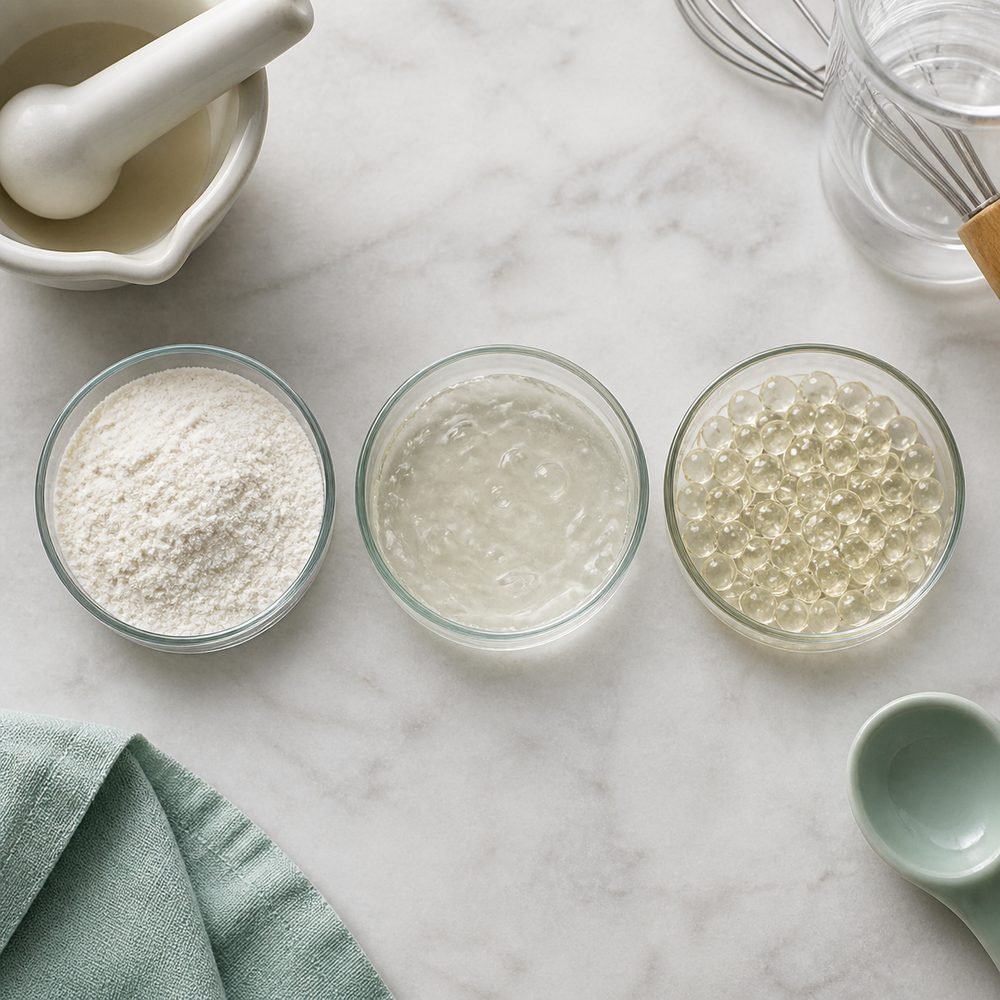
The same raw material can move from a dry powder to a hydrated solution and then to a calcium-set gel.
What is sodium alginate used for in food?
Food is the most visible area for sodium alginate uses because the ingredient can improve texture without adding a strong flavor. Food-grade sodium alginate may be used in sauces, dressings, beverages, dairy and frozen products, bakery items, confectionery, restructured foods, and plant-based formulations. The exact permitted use and level depend on the market, product category, and local food regulations.
For product developers, HONRY CHEMICAL food and beverage solutions provide a relevant starting point for reviewing ingredient applications and formulation support.
Thickening and stabilization
In sauces, dressings, and beverages, sodium alginate can help create a more consistent mouthfeel and slow the separation of dispersed ingredients. It can also support a smooth texture in systems that contain particles or an oil phase. The amount and grade must be matched to the desired viscosity: too little may have little visible effect, while too much can produce an overly heavy or stringy texture.
In frozen desserts, hydrocolloids are commonly used to manage water and texture during freezing and storage. Sodium alginate may contribute body and stability, but it is not a universal replacement for every stabilizer. A formulator should test it with the complete recipe, because sugar, proteins, minerals, acidity, and processing conditions affect hydration and final texture.
Gels, fillings, and confectionery
Sodium alginate can help create gel-like foods, fillings, and confectionery structures. Calcium may come from another ingredient or be added deliberately to control the setting reaction. The result can range from a soft, spoonable gel to a firmer formed piece, depending on concentration and processing.
Restructured foods and plant-based products
Alginate systems can help bind particles in products that are shaped, sliced, or restructured. In plant-based foods, the ingredient may support a cohesive texture alongside proteins, starches, fibers, oils, and other hydrocolloids. It should be evaluated for bite, water release, freeze-thaw behavior, and compatibility with the full ingredient list.
Edible films and encapsulation
Sodium alginate can be cast into films or formed into beads and capsules. Research has explored these structures as carriers for flavors, colors, probiotics, nutrients, and other functional ingredients. The attraction is that calcium-mediated gelation can occur under relatively mild conditions and the network can be tuned for swelling and release.
These are formulation capabilities, not automatic product claims. An encapsulated ingredient still needs appropriate stability testing, food-safety review, packaging evaluation, and regulatory assessment.
Sodium alginate and culinary spherification
Spherification is one of the clearest demonstrations of sodium alginate uses. A flavored liquid is turned into small spheres with a liquid center and a thin gel membrane. The effect resembles caviar and is used in modernist cooking, beverages, desserts, and plated dishes.
There are two common approaches:
Basic spherification
In basic spherification, sodium alginate is blended into the flavored liquid. Drops of that mixture are placed into a calcium lactate or calcium gluconate bath. Calcium moves into the drop and forms a membrane around it. This approach can produce a delicate skin, but it is sensitive to calcium already in the liquid and to strong acidity.
Reverse spherification
In reverse spherification, calcium is placed in the flavored liquid and sodium alginate is dissolved in the bath. This arrangement is often more flexible for liquids that already contain calcium, dairy, alcohol, or more acidity. The spheres can be rinsed after setting, and the reaction can be slowed or stopped once they leave the alginate bath.

Spherification depends on controlling the location of sodium alginate and calcium so a membrane forms at the desired rate.
Practical spherification controls
The powder should be dispersed gradually while mixing to reduce clumps. An immersion blender can help, but it also introduces air, so the solution may need time to rest before use. Deionized or low-calcium water is often preferred for an alginate bath because calcium in hard or mineral-rich water can trigger premature gelation.
Acidity is another important variable. Very acidic liquids may prevent basic spherification from working as intended. A chef or food technologist should test pH and use a suitable buffering strategy only when the recipe and safety review support it. Precise scales, clean baths, consistent drop size, and careful rinsing improve repeatability.
Sodium alginate in pharmaceutical and medical applications
Sodium alginate and other alginates are used in pharmaceutical and medical formulations because they can hydrate, thicken, form gels, and create a physical barrier. Examples include excipient systems, dental impression materials, wound dressings, topical gels, and controlled-release research. The required specification is very different from that of a culinary ingredient.
Alginate-based materials are also studied in hydrogels, tissue engineering, drug delivery, and cell encapsulation. These applications usually require a carefully controlled grade, sterilization or bioburden strategy, defined gel behavior, and evidence appropriate to the intended medical use. A food-grade material should not be presented as a pharmaceutical or medical-grade substitute.
There is also an important distinction between sodium alginate as an industrial raw material and alginate-containing medicines. Cleveland Clinic explains that alginates used in some reflux products can form a raft-like barrier that helps reduce acid moving from the stomach toward the esophagus. That patient-facing information concerns a finished, regulated treatment and does not mean that raw sodium alginate powder should be self-administered or used as a home remedy. Anyone considering an alginate medicine should follow the product label and speak with a healthcare professional when needed, especially with kidney disease, medication interactions, pregnancy, or persistent symptoms.
Sodium alginate in cosmetics and personal care
Cosmetic formulators use sodium alginate as a thickener, film former, stabilizer, and texture modifier. It can appear in masks, gels, creams, lotions, hair products, and toothpaste formulations. In a face mask, for example, alginate can contribute to a smooth, spreadable system that sets into a flexible film when the formulation is designed to do so.
The final feel depends on the grade and the rest of the formula. Humectants, salts, preservatives, pigments, botanical extracts, surfactants, and pH adjusters may affect viscosity and compatibility. A clean dispersion procedure is important because undissolved particles can leave a grainy texture or create inconsistent performance.
Industrial, technical, and research uses
Beyond food and personal care, sodium alginate can be used in technical materials and laboratory research. Its ability to form hydrated networks supports work on films, beads, adsorbents, coatings, and composite hydrogels. Researchers have investigated alginate-based materials for controlled release, water treatment, and the immobilization of active substances.
These uses often require modification or combination with another material. Pure sodium alginate gels can be soft and sensitive to water exchange, so a technical formulation may add another polymer, particle, fiber, or crosslinking method. The performance has to be measured under the actual pH, ionic strength, temperature, and mechanical conditions of use.
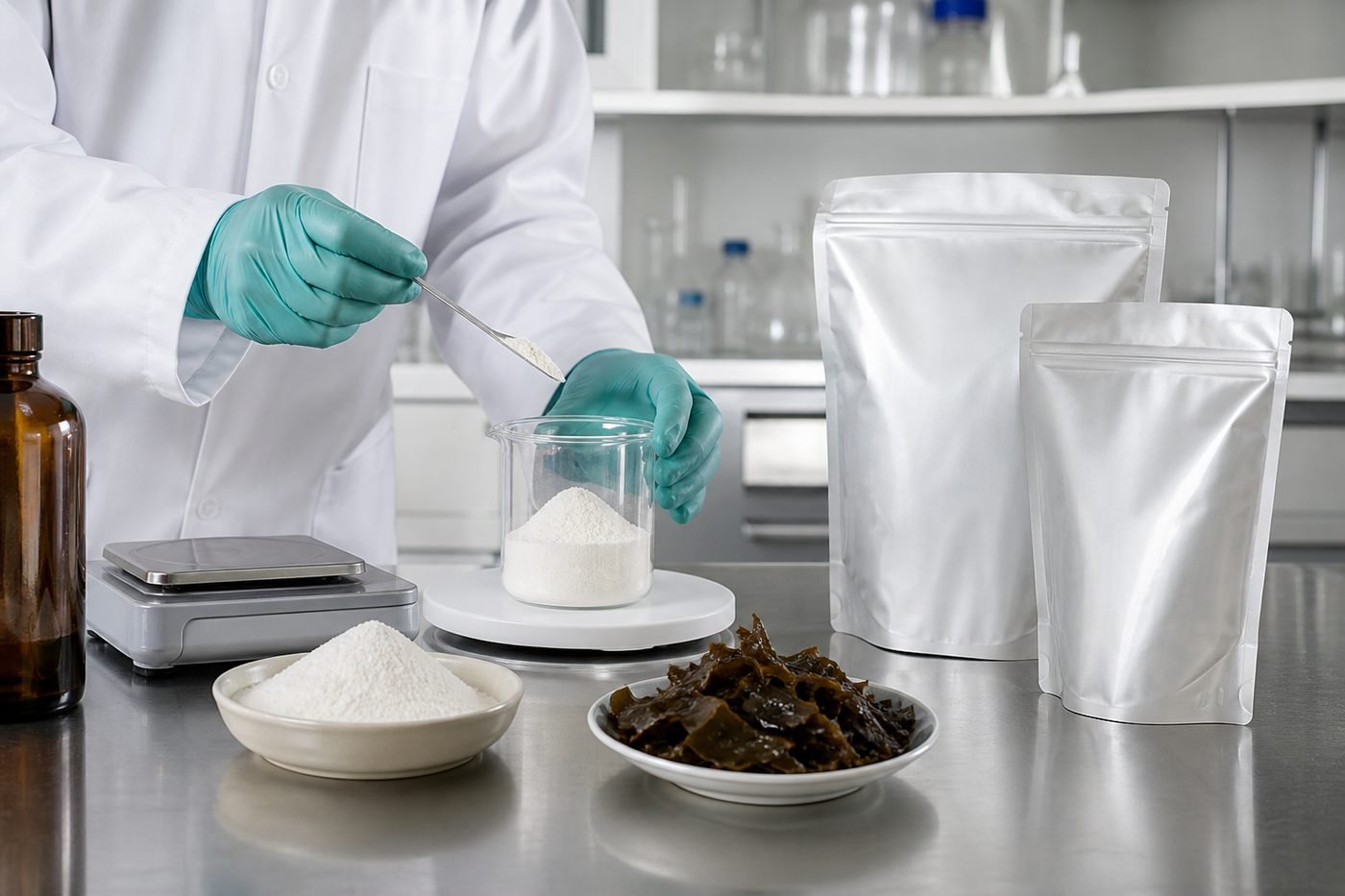
For commercial applications, the powder specification and quality-control documentation matter as much as the name on the bag.
What is sodium alginate powder, and how should you choose it?
Sodium alginate powder is the dry commercial form used for transport, storage, weighing, and incorporation into a formulation. Choosing the right powder involves more than comparing price per kilogram.
Sodium alginate food grade versus other grades
The phrase “sodium alginate food grade” describes suitability for a food application under the relevant regulatory and quality system; it does not describe one universal performance level. Two food-grade powders can still differ in viscosity, hydration speed, gel strength, color, and recommended use level. A beverage may need a different grade from a molded confection, even when both products meet food requirements.
| Selection factor | Why it matters | Questions to ask the supplier |
| Application grade | Food, cosmetic, technical, and medical uses have different controls | Is the grade documented for the target market and use? |
| Вязкость | Changes mixing, pumping, texture, coating, and droplet formation | What test method and temperature define the viscosity? |
| Gel behavior | Controls membrane formation, bead strength, and setting speed | How does it perform at the intended calcium level and contact time? |
| Purity and microbiology | Supports safety, compliance, and batch release | Which limits and certificates are included in the COA? |
| Storage and shelf life | Moisture can affect flow, clumping, and hydration | What packaging, storage, and after-opening instructions apply? |
Table 2. Sodium alginate powder selection checklist
For a product-specific reference, review the sodium alginate product page for the supplier’s listed parameters and application description.
Other grades are selected for different reasons. A cosmetic formula may prioritize skin feel, color, odor, and microbiological controls. A technical hydrogel may prioritize a particular molecular weight or cross-linking response. A pharmaceutical or medical material may require additional controls for impurities, bioburden, traceability, and validated processing. These categories should be kept separate in purchasing and production records. If a supplier offers samples, test the exact lot in the complete formula before approving a larger order.
1. Start with the application grade
Food, cosmetic, technical, pharmaceutical, and research applications may have different purity, testing, documentation, and traceability requirements. If the final product is food, ask for a food-grade specification and confirm it is suitable for the target market. Do not assume that a technical grade is acceptable for consumption.
2. Match viscosity to the process
Viscosity grade affects pumping, mixing, coating, extrusion, droplet formation, and final texture. A high-viscosity grade may give stronger body at lower use levels, but it can also be harder to disperse and process. A lower-viscosity grade may be easier to handle in a spray, beverage, or delicate bead system.
3. Consider gel strength and gel speed
For calcium-set products, ask how the grade behaves in the intended calcium concentration and process time. A fast-setting system may be useful for a thin membrane but difficult to fill or shape. A slower system can allow better processing control but may need a longer residence time.
4. Review the certificate of analysis
Useful documents may include identity, appearance, moisture, viscosity, pH, ash, microbiological limits, heavy-metal limits where relevant, allergen statements, origin, batch traceability, and packaging details. The exact list should match the application and regulatory expectations.
| Document or test | What it helps verify | When it is especially important |
| Certificate of analysis | Identity, batch values, and release criteria | Every commercial lot and new supplier |
| Viscosity and gel data | Repeatability in the finished process | Sauces, beads, coatings, hydrogels, controlled release |
| Microbiological results | Hygiene and grade suitability | Food, cosmetics, pharmaceuticals, medical materials |
| Heavy metals / impurities | Application-specific purity and compliance | Food, regulated products, and sensitive formulations |
| Traceability and origin | Ability to investigate a batch or raw-material issue | Long-term supply and regulated markets |
Table 3. Supplier documentation for sodium alginate
5. Check dispersion and packaging requirements
Powder quality includes how easily it wets and hydrates, not only its chemical identity. Ask about recommended storage, shelf life, bag size, liner material, and protection from humidity. Sodium alginate is hygroscopic enough that poor storage can affect flow and clumping.
For companies comparing suppliers, ХОНРИ ХИМИКАЛ provides a starting point for reviewing sodium alginate product information and discussing an application-specific specification. A supplier conversation should cover the finished product, process conditions, target market, documentation, and required sample testing rather than relying on a generic product name.
You can also review HONRY CHEMICAL’s About Us page to understand its ingredient, R&D, and quality-system scope.
Common mistakes when using sodium alginate
Adding the powder too quickly
Dumping the full dose into water often creates fish-eyes: hydrated material on the outside with dry powder trapped inside. Add slowly into a moving liquid, use suitable shear, and allow time for complete hydration.
Ignoring calcium in the water
Hard water or mineral water can contain enough calcium to cause premature thickening or gel particles. This is especially troublesome in spherification and controlled droplet processes.
Treating every grade as identical
Two powders labeled sodium alginate may behave very differently. Viscosity, molecular characteristics, purity, moisture, and particle size all matter.
Assuming more powder always means a better gel
More alginate can increase viscosity and change gel texture, but it may also create a gummy mouthfeel, slow dispersion, trap air, or make the process difficult. Adjust concentration through small controlled trials.
Forgetting the order of addition
Calcium, acids, salts, proteins, and other hydrocolloids may change the way alginate hydrates or gels. Build a simple process sequence and validate it with the complete formula.
Confusing “natural” with “automatically safe in every use”
Seaweed origin does not remove the need for grade control, sanitation, regulatory review, or dosage evaluation. Food-grade, cosmetic-grade, and medical-grade specifications serve different purposes.
Storage and handling guidance
Keep sodium alginate powder in its original sealed packaging or a clean, moisture-resistant container. Store it in a cool, dry environment away from strong odors and direct contamination. Close the package promptly after sampling. If the powder has formed hard lumps, changed color, developed an unusual odor, or exceeded its stated shelf life, quarantine it until quality personnel determine whether it remains suitable.
For production, use clean, dry tools and follow a documented batch procedure. Record lot number, weighed quantity, water quality, mixing time, temperature, pH where relevant, and gel or viscosity results. These simple records make it easier to identify whether a problem came from the powder, the water, the mixing step, or another ingredient.
Frequently asked questions
Is sodium alginate the same as alginic acid?
No. Sodium alginate is the sodium salt form of alginic acid. The salt form is commonly used because it disperses in water and can be converted into a calcium alginate gel.
Is sodium alginate vegan?
It is derived from brown algae rather than animals, so it is often compatible with vegan formulations. However, a finished product can contain other non-vegan ingredients, and certification or supplier documentation may be needed for a specific claim.
Does sodium alginate dissolve in cold water?
It can hydrate in cold water, which is one reason it is useful in cold-processing systems. It should be dispersed carefully because the outside of a particle can hydrate before the inside, causing clumps.
Is sodium alginate powder edible?
Only a suitable food-grade product used within an appropriate formulation should be considered for food use. Technical or laboratory powder should not be treated as edible. Always check the grade, label, supplier documentation, and applicable regulations.
Why does my sodium alginate solution have lumps?
Common causes include adding powder too quickly, insufficient mixing, high local concentration, or allowing the powder to contact water without enough movement. Gradual addition, better dispersion, and adequate hydration time usually improve the result.
Can sodium alginate be used with calcium?
Yes. Calcium ions are commonly used to cross-link alginate and form gels. The calcium source, concentration, contact time, and process order determine whether the result is a thin membrane, bead, or bulk gel.
Is sodium alginate a thickener or a gelling agent?
It can be both. In water without enough calcium, it mainly contributes viscosity. In the presence of suitable divalent ions, it can form a gel network.
Final verdict
Sodium alginate is a versatile seaweed-derived hydrocolloid whose value comes from controllable hydration and calcium-triggered gelation. Its sodium alginate uses range from thickening sauces and stabilizing food systems to making spherification membranes, cosmetic gels, pharmaceutical excipients, wound-care materials, and research hydrogels.
For samples or a specification discussion, use the HONRY CHEMICAL contact page.
For a reliable result, choose the grade for the finished application, match viscosity and gel behavior to the process, control water and calcium, disperse the sodium alginate powder gradually, and verify the specification with supplier documentation and testing. Food manufacturers looking specifically for sodium alginate food grade should treat grade, traceability, and regulatory suitability as selection criteria—not afterthoughts.
For a product-specific reference, review the sodium alginate product page for the supplier’s listed parameters and application description.
