 Loncat ke konten



A practical quality guide for supplement brands and procurement teams buying bulk astaxanthin.
Two powders sit on the same lab bench. Both are deep red. Both pass a 5% assay. One comes from microalgae grown in closed photobioreactors. The other was built in a petrochemical plant. Your label, your capsule shell, and your customer cannot tell them apart by looking.
That is the problem with astaxanthin sourcing. The name on the certificate of analysis is the same, but the molecule inside is not. Natural astaxanthin from Haematococcus pluvialis arrives mostly esterified, with one dominant stereoisomer. The synthetic version is free-form and racemic. Each difference changes stability, bioavailability, and what you can legally claim.
Price follows the same split. Natural material costs several times more per kilogram, so cheap quotes usually hide a source question. If you cannot read the difference on paper, you cannot defend the price you pay.
In this post, you’ll learn how natural and synthetic astaxanthin actually differ, which COA lines separate them, how to match 5% and 10% grades to your dosage form, and which supplier answers should make you walk away.
Quick answer: Natural and synthetic astaxanthin are not the same ingredient. Natural astaxanthin from Haematococcus pluvialis is mostly esterified and dominated by the (3S,3’S) isomer, the form found in wild salmon. Synthetic astaxanthin is free-form and a racemic mix of three isomers in roughly a 1:2:1 ratio. Natural material is more stable in storage and is the form used in human trials. Synthetic material is cheaper and still dominates aquaculture colouring. For supplements, food, and skincare, buyers should specify the algal source, the isomer profile, and the ester ratio on the COA, not just a total assay number.
What Is Astaxanthin and Why the Source Matters
Astaxanthin is a red carotenoid with the formula C₄₀H₅₂O₄ and CAS number 472-61-7. It belongs to the xanthophyll group, alongside lutein and zeaxanthin. Unlike beta-carotene, your body does not convert it into vitamin A.
Microalgae make it as a stress response. When Haematococcus pluvialis runs out of nutrients or gets hit by strong light, it turns from green to red and packs the cell with astaxanthin. That pigment then travels up the food chain. It is why salmon, krill, and flamingo feathers carry the same colour.
A carotenoid made by microalgae
The algal cell does not store astaxanthin as a bare molecule. It links it to fatty acids, mostly as monoesters and diesters. This esterified form sits inside lipid droplets and resists oxidation better than the free molecule. That detail matters later when we read a COA.
Why two supply chains exist
Global output splits into two very different businesses. Synthetic astaxanthin is produced from petrochemical intermediates for a few hundred to around a thousand dollars per kilogram. It colours farmed salmon and shrimp, and it covers the great majority of total volume.
Natural astaxanthin is grown, stressed, harvested, dried, and extracted. Nutraceutical-grade material from H. pluvialis typically sells for several thousand dollars per kilogram. It goes into capsules, gummies, drinks, and skincare.
So when a quote looks too good, ask which chain it came from. The answer decides everything that follows.
The Four Chemical Differences Between Natural and Synthetic Astaxanthin
Both materials pass the same name test. Neither passes the structure test.
1. Stereoisomer profile
Astaxanthin has three chiral centres, so the molecule can exist in several mirror-image forms. Algal astaxanthin is dominated by the (3S,3’S) isomer. Synthetic astaxanthin is a racemic blend of (3S,3’S), (3R,3’S), and (3R,3’R), close to a 1:2:1 ratio. The (3R,3’S) form does not occur in nature.
If a COA prints only “total astaxanthin 5.0%”, it tells you nothing here. Two suppliers can both hit 5% and ship different molecules.
2. Esterified versus free
In the algal cell, astaxanthin is bound to fatty acids. Monoesters and diesters protect the conjugated chain from oxygen, which is why natural extracts keep their colour longer. Synthetic astaxanthin is free, with no fatty acid attached. Free forms are cheaper to make and easier to standardise, but they age faster.
3. Co-carotenoids in the matrix
A natural extract is not a single molecule. It carries small amounts of lutein, beta-carotene, and canthaxanthin from the same algal biomass. Those co-factors come along with the esterified astaxanthin. Synthetic material is essentially one compound, purified.
4. Cis and trans forms after processing
Heat, light, and oxygen push all-trans astaxanthin toward cis isomers. Drying and extraction conditions decide how much. A well-run natural process keeps the all-E dominant profile. A harsh one does not, and the colour dulls even when the assay still reads 5%.
| Feature | Natural (H. pluvialis) | Synthetic |
|---|---|---|
| Primary source | Cultivated microalgae | Petrochemical intermediates |
| Dominant isomer | (3S,3’S), all-E | Racemic 1:2:1 mix |
| Molecular form | Mono- and diesters | Free astaxanthin |
| Co-carotenoids | Present in the algal matrix | Minimal |
| Oxidation resistance | Higher, ester-protected | Lower |
| Typical use | Supplements, food, cosmetics | Aquaculture colouring |
| Price band | Several thousand USD/kg | Hundreds to ~1,000 USD/kg |
None of this makes synthetic material “bad”. It makes it a different ingredient with a different job. The mistake is buying one and labelling it as the other.
What the “6,000 Times Stronger” Claim Misses
Every astaxanthin brochure carries the same numbers. 6,000 times vitamin C. 800 times CoQ10. 550 times vitamin E.
They come from a single lab test. Researchers measured how fast each molecule quenches singlet oxygen in an organic solvent. That is a chemistry comparison, not a health claim. It compares single molecules in a tube, not doses in a person. Vitamin C works in watery compartments, and astaxanthin works in membranes, so the test is not really a contest.
Human data looks different. Reviewers who pooled the trials found little change in blood antioxidant markers. The clearer signals sit in skin moisture and elasticity, and in self-reported eye fatigue among screen users. Those effects are modest, and several trials were funded by ingredient makers.
Why does this matter to a buyer? Because your marketing team will want those numbers on the label. Some markets allow the comparison only with careful wording. The EU caps astaxanthin in supplements at 8 mg per day, and EFSA treats it as a novel food ingredient with a defined intake level. Health Canada allows an antioxidant claim, not a disease claim.
The safe position is simple. Sell the source, the assay, and the purity. Let the 6,000x line stay in the brochure. A brand that leans on structure-function wording it cannot defend is one complaint away from a relabel.
Reading an Astaxanthin COA: Five Specs That Matter
Most astaxanthin certificates look reassuring and say almost nothing. Moisture, ash, mesh, total assay. Every algal powder passes those. The lines below are the ones that separate sources.
Isomer profile and free-to-ester ratio
Ask for the stereoisomer breakdown and the esterified share. A genuine H. pluvialis extract should show an all-E dominant (3S,3’S) profile and a high ester ratio. A free-form, racemic result points to synthetic material or a blend.
Lambda max and colour value
Astaxanthin absorbs light at roughly 470–480 nm. The exact maximum and the ratio between peaks act as a fingerprint. If lambda max drifts between lots, oxidation or substitution started before the colour changed.
Oxidation stability
This is the real shelf-life risk, and moisture will not warn you. Request the stability statement and packaging spec. Nitrogen-flushed aluminium foil is standard for a reason.
Algal contaminants
Algal biomass carries risks that a synthetic route does not. Microcystins are the one to watch. A serious grower screens every batch and reports “not detected” against a stated limit, alongside aflatoxin.
Heavy metals and microbiology
Lead, arsenic, mercury, and cadmium limits are routine but not identical across suppliers. So are total plate count and pathogen screens. Compare the numbers, not the tick boxes.
| COA parameter | What to accept | Why it matters |
|---|---|---|
| Astaxanthin assay | ≥5.0% or ≥10.0% by HPLC or UV, method stated | A number without a method is not verifiable |
| Isomer profile | All-E dominant, (3S,3’S) | Confirms algal origin |
| Free / esterified ratio | Esterified share reported | Predicts stability |
| Lambda max | ~470–480 nm, stable across lots | Detects oxidation or adulteration |
| Kelembaban | ≤6,0% | Supports shelf life, not a quality proof alone |
| Abu | ≤5,0% | Indicates biomass residue |
| Logam berat | Pb, As, Hg ≤1 ppm; Cd ≤0.1 ppm | Food and supplement compliance |
| Mikrocistin | Not detected, limit stated | Algal-specific toxin risk |
| Microbiology | TPC ≤1,000 CFU/g; pathogens negative | Capsule and beverage safety |
The EU novel food framework sets the legal frame for astaxanthin in food supplements, and the Union list is worth reading before you write a label. For the chemistry behind these parameters, the Marine Drugs review by Ambati et al. is still the clearest starting point.
Powder, Oleoresin, or CWD Powder: Matching Grade to Dosage Form
Natural astaxanthin is sold in a narrow set of formats. Pick the wrong one and your line slows down, or your label claim gets harder to hit.
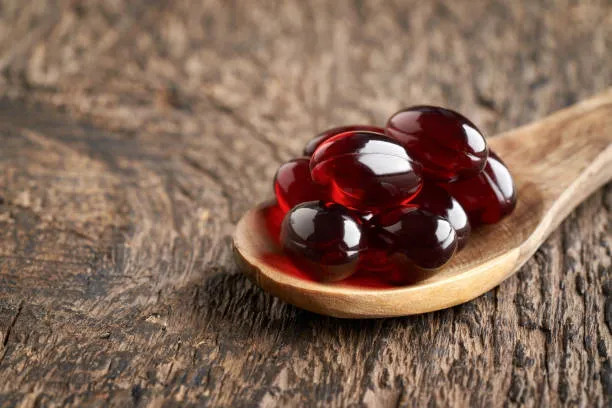
Oleoresin (5% and 10% oil). A dark red, viscous liquid, usually supercritical CO₂ extracted. It disperses straight into oils, so it is the natural choice for softgel fills, oil drops, and cosmetic serums. No milling, no dusting. Higher concentrations mean less carrier oil in the fill.
Powder (5% and 10%). Standardised algal extract on a carrier, typically 80 mesh. It flows into capsules, tablets, and stick packs. Powder is easier to weigh and blend, but it is also easier to oxidise, so packaging discipline matters more.
Cold-water dispersible powder. Microencapsulated so it spreads in water without an emulsifier. This is the grade for ready-to-drink formats, instant mixes, and gummies where an oily phase would separate.
The 5% versus 10% question is arithmetic and cost. If your dose is 4 mg per capsule and your fill weight is 500 mg, a 5% grade needs 80 mg of extract. A 10% grade needs 40 mg, which leaves more room for carrier oil and excipients. Higher assay also means less powder to ship, store, and test.
| Dosage form | Recommended grade | Reason |
|---|---|---|
| Softgel capsule | 5% or 10% oleoresin | Lipid-soluble, no dispersion step |
| Two-piece capsule | 5% powder, 80 mesh | Good flow, simple blending |
| Tablet | 5% or 10% powder | Compressible with standard excipients |
| Stick pack / sachet | 5% powder or CWD | Fast dispersion, low dose per unit |
| Ready-to-drink beverage | CWD powder | Clear dispersion in water |
| Gummy | CWD or 10% oleoresin | Heat and dose dependent |
| Serum or face oil | 10% oleoresin | Soluble in the oil phase |
Ask your supplier for a trial sample in the exact grade you plan to run. A 5% powder that performs well in capsules may bridge in a stick pack.
Bulk Astaxanthin Specifications Buyers Should Confirm
Here is a working specification for natural astaxanthin 10% oil, drawn from the parameters Honry Chemical releases on each lot. Use it as a template when you compare quotes.
| Parameter | Spesifikasi | Metode |
|---|---|---|
| Product name | Astaxanthin 10% Oil | — |
| CAS / EINECS / HS | 472-61-7 / 207-451-4 / 3203.00 | — |
| Penampilan | Dark-red oleoresin, no burnt or rancid odour | Visual, organoleptic |
| Astaxanthin content | ≥10,0% | UV |
| Kelembaban | ≤6,0% | Gravimetrik |
| Abu | ≤5,0% | Gravimetrik |
| Arsenik | ≤1.0 ppm | ICP-MS |
| Memimpin | ≤1.0 ppm | ICP-MS |
| Merkuri | ≤1.0 ppm | ICP-MS |
| Kadmium | ≤0,1 ppm | ICP-MS |
| Jumlah piring total | ≤1.000 CFU/g | Plate count |
| Ragi dan jamur | ≤100 CFU/g | Plate count |
| Coliforms | ≤30 MPN/100 g | MPN |
| E. coli, Salmonella, Staphylococcus, Shigella | Negatif | Compendial |
| Available forms | 5% or 10% powder; 5% or 10% oil | — |
| Kemasan | Light-protected bulk container, nitrogen flush on request | — |
| Penyimpanan | Unopened, protected from light, dry, ≤25 °C | — |
| Shelf life | 2 years when stored correctly | — |
Powder grades swap the assay and add a mesh line, usually 80 mesh with 100% pass. Everything else should hold.
How to Vet an Astaxanthin Supplier
A supplier who answers with a Latin name, a strain record, and a batch COA is a different proposition from one who answers with a price. Run the same five checks on every candidate.
Documents first. Ask for the spec sheet, a recent COA with lot number, the MSDS, and any certification you need for your market. GMP, ISO 22000, and BRCGS cover the plant. Organic and kosher or halal certificates cover the claim.
Then the sample. Test the sample against the COA, not against the marketing deck. Send it to a third-party lab for assay, isomer profile, and heavy metals. A supplier whose sample diverges from the paper will diverge at scale.
Then the origin story. Which species, which strain, which farm? Algal astaxanthin comes from open ponds and closed photobioreactors, and the two give different contamination profiles. A supplier who cannot name the cultivation site cannot trace a recall.
Then the capacity. Ask for monthly output and lead time in writing. Natural astaxanthin supply tightens when a harvest underperforms, and spot buyers get pushed to the back of the queue.
Then the paperwork discipline. Every shipment should carry its own COA, not a generic file. Packaging should be light-protected and, for long sea freight, nitrogen flushed.
Red flags are easy to spot once you know the pattern. A COA without a lot number. “Natural” with no species. An assay with no analytical method. A price far below the natural range. An answer to the isomer question that never mentions isomers.
If you need a specification reviewed against your formulation, send the details to our team and we will map the grade to your dosage form.
Storage, Packaging, and Shelf Life
Astaxanthin fails in three ways. Light bleaches it. Heat isomerises it. Oxygen oxidises it. Whichever comes first sets your real shelf life, whatever the certificate says.
Keep bulk material in the original unopened package, away from light, in a dry place at or below 25 °C. Once a drum is opened, the clock speeds up. Purge the headspace with nitrogen if the material will sit for weeks, and reseal immediately after weighing.
For finished goods, the same logic applies inside the capsule. A softgel filled with oleoresin is well protected. A powder in a clear bottle is not. Amber glass, opaque HDPE, or an aluminium blister all buy time.
Expect two years of shelf life from production when storage is right. Plan a retest at 18 months for slow-moving SKUs. If colour shifts from deep red toward brown, oxidation has started. The assay may still pass while the customer sees the difference.

Freight is where most damage happens. A container on a dock in summer can exceed 50 °C. Ask for insulated stowage or a temperature-controlled route if your destination is hot, and check the seals on arrival.
Applications and What Each One Demands
The same molecule behaves differently across categories, and the demand changes with it.
Dietary supplements. Capsules and softgels dominate. Buyers want 5% or 10% material with a clean COA and a dose that matches the label. Softgel fill is the most forgiving format for oleoresin.
Functional food and beverage. Colour is a feature here, not a side effect. A beverage needs a cold-water dispersible grade, plus a stability trial in your own matrix. Heat treatment will cost you some pigment.
Cosmetics. Skincare uses oleoresin in serums and creams. Cosmetic grade needs its own heavy-metal limits and often a solvent-residue statement. Formulators pair it with vitamin E to protect the oil phase.
Aquaculture and pet. This is where synthetic material still wins on cost. Natural astaxanthin earns its premium in premium-positioned feed, especially where the label promises an algal source.
Honry Chemical supplies natural astaxanthin as 5% and 10% powder and oil, with per-lot COA and light-protected bulk packaging. If you are building a formulation around astaxanthin, compare the grade against your dosage form before you compare price. Our antioxidant ingredient range covers the usual companion actives, from vitamin C to coenzyme Q10.
PERTANYAAN YANG SERING DIAJUKAN
Is natural astaxanthin better than synthetic?
For supplements, food, and skincare, yes. Natural astaxanthin from Haematococcus pluvialis is esterified and dominated by the (3S,3’S) isomer, the form used in human trials. It resists oxidation better and carries co-carotenoids from the algal matrix. Synthetic astaxanthin is free-form and racemic, with lower stability and no human safety file at supplement doses. For aquaculture colouring, synthetic still makes commercial sense because cost dominates and the pigment performs.
What is the difference between 5% and 10% astaxanthin?
It is concentration, not quality. A 10% grade carries twice as much astaxanthin per gram, so you use half the powder or oil to hit the same dose. Higher grades save space in the capsule and reduce freight and storage cost per unit of activity. They also cost more per kilogram. Choose based on your dose per serving and how much room your formulation has.
How much astaxanthin is used in supplements?
Most clinical work used 4 to 12 mg per day, taken with a meal that contains fat. General antioxidant products sit at 4 to 6 mg. Skin and eye formulas usually land between 6 and 12 mg. The EU sets 8 mg per day as the safe level for supplements, so a product sold in Europe above that figure needs a different regulatory route.
Is astaxanthin really 6,000 times stronger than vitamin C?
Only in a narrow lab test. That figure comes from measuring how fast single molecules quench singlet oxygen in an organic solvent. It compares molecules, not doses, and says nothing about absorption or effect in the body. Human trials show modest changes in skin and eye outcomes and little movement in blood antioxidant markers. Treat the number as chemistry, not as a label claim.
How should bulk astaxanthin be stored?
Keep it unopened in a light-protected container, in a dry place at or below 25 °C. Astaxanthin degrades with light, heat, and oxygen, so nitrogen flushing helps once a package is opened. Shelf life is about two years from production under correct storage. For long sea freight in hot climates, request insulated stowage and inspect seals on arrival.
Kesimpulan
Natural and synthetic astaxanthin share a name and a colour, nothing more. The isomer profile, the ester bond, and the COA tell you which one is in the bag. Specify the source, demand the isomer breakdown, and test a sample before you sign. That is how you protect both the label claim and the price you pay.
