 İçeriğe geç

If you work in coating formulation, industrial manufacturing, or chemical procurement, methyl acetate is likely already part of your supply chain — or it should be.
Known by its chemical formula CH₃COOCH₃ and CAS number 79-20-9, methyl acetate is a fast-evaporating ester solvent with a mild fruity odor and broad resin compatibility. While it has applications across several industries, its most significant and well-established role is in paints, coatings, and surface finishing formulations.
This guide focuses specifically on the practical uses of methyl acetate for coating professionals — from automotive refinishing and industrial surface coatings to wood lacquers and printing inks. If you’re looking for a full technical overview of the compound itself, see our guide: What is Methyl Acetate?
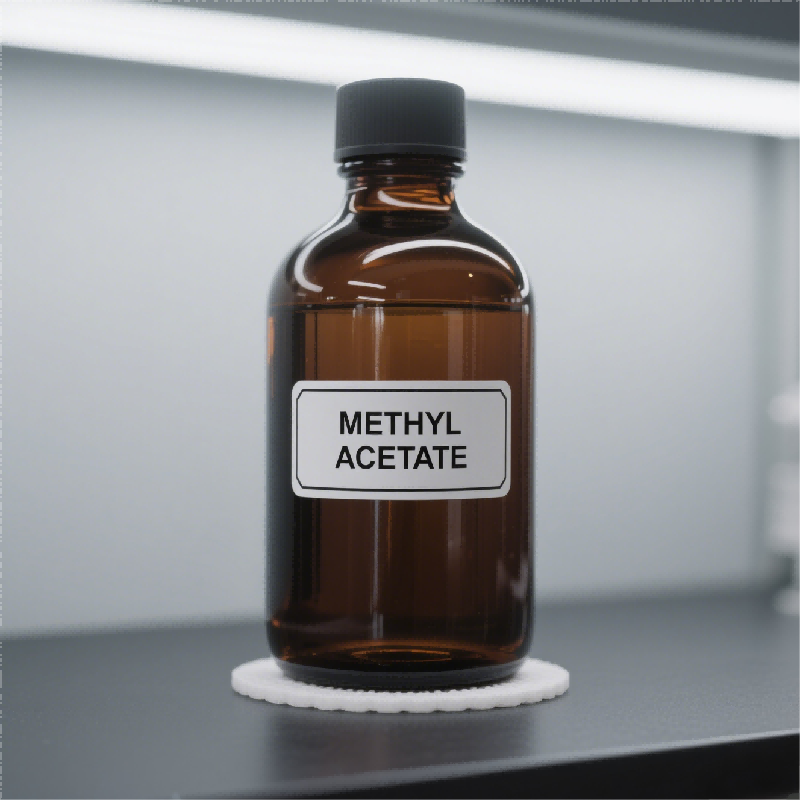
Why Methyl Acetate Matters in Coating Formulations
Choosing the right solvent is one of the most consequential decisions in coating formulation. The solvent you select directly affects drying time, film formation quality, resin compatibility, application viscosity, and — increasingly — regulatory compliance.
Methyl acetate addresses all of these factors in a way few solvents can match simultaneously:
- Fast evaporation rate — Its evaporation rate is significantly higher than ethyl acetate, enabling quick dry-to-touch times and faster production cycles.
- Broad resin solvency — Methyl acetate is an active solvent for nitrocellulose, cellulose esters, acrylics, vinyl copolymers, epoxies, alkyds, polyamides, and polyesters — covering the majority of resin systems used in modern coatings.
- VOC-exempt status — Under U.S. EPA regulations, methyl acetate is classified as a VOC-exempt compound. It is also non-HAP (not a Hazardous Air Pollutant) and non-ODS (not an Ozone-Depleting Substance). For formulators under pressure to reduce VOC content without sacrificing performance, this is a critical advantage.
- Mild odor profile — Compared to acetone or MEK, methyl acetate offers a noticeably milder odor, improving working conditions in production environments.
These properties have made methyl acetate one of the most widely used ester solvents in the paints and coatings sector — its single largest end-use market globally.
Primary Uses of Methyl Acetate in Coatings
Solvent for Nitrocellulose & Cellulose Esters
One of the most well-established uses of methyl acetate in the coatings industry is as a solvent for nitrocellulose (NC) and cellulose ester-based systems. Methyl acetate dissolves nitrocellulose rapidly and completely, producing stable, low-viscosity solutions that are essential for consistent film formation.
This makes it a preferred solvent in:
- Wood furniture lacquers — where clarity, fast drying, and smooth film build are critical
- Industrial primers and sealers — formulated on nitrocellulose or cellulose acetate butyrate (CAB) platforms
- Cellulose ester coatings for leather finishing and flexible substrates
For formulators working with NC-based systems, methyl acetate offers a reliable alternative to acetone — with comparable solvency power but a significantly milder odor and better retention characteristics in high-low solvent blend systems.
Automotive Refinishing Coatings
In automotive refinishing, production efficiency and surface quality are non-negotiable. Methyl acetate’s fast evaporation rate makes it particularly well-suited for fast-drying topcoats, basecoats, and clearcoats used in body shop environments.
Its key contributions in this application include:
- Reduced flash-off time between coats, shortening overall refinishing cycles
- Improved atomization in spray application due to its low viscosity in solution
- VOC compliance support — allowing formulators to meet increasingly strict regional VOC limits without reformulating to lower-performance alternatives
As automotive OEM and refinish coating manufacturers face growing environmental scrutiny, methyl acetate’s VOC-exempt classification has elevated its role from a performance solvent to a strategic formulation ingredient.
Industrial Surface Coatings
Methyl acetate is widely used in solvent-borne industrial coatings applied to steel structures, machinery, pipelines, and heavy equipment. Its compatibility with a broad range of industrial resin systems — including epoxies, alkyds, polyesters, and vinyl copolymers — makes it a versatile choice for formulation teams working across multiple product lines.
In high-build industrial coatings, methyl acetate is typically used as the fast-evaporating component in a blended solvent system, where it drives initial surface drying while slower-evaporating solvents regulate film flow and leveling. This balance between speed and finish quality is difficult to achieve with single-solvent systems.
Wood Varnishes & Furniture Lacquers
The wood coatings segment is one of the heaviest consumers of methyl acetate globally. Its fast evaporation profile directly supports high-throughput finishing lines in furniture manufacturing, where coating, drying, and sanding cycles must move quickly.
Beyond drying speed, methyl acetate offers practical formulation benefits in wood coatings:
- Lowers solution viscosity without compromising resin solids content
- Produces a clean, bright film with minimal yellowing
- Compatible with UV-curable and conventional lacquer systems
For wood coating manufacturers supplying the construction and furniture sectors, methyl acetate strikes a practical balance between application performance and regulatory compliance.
Baskı Boyaları
In gravure and flexographic printing — particularly for flexible packaging — solvent selection directly impacts print quality, ink transfer efficiency, and line speed. Methyl acetate is used in solvent-based ink formulations where fast solvent release is required to achieve sharp print definition and prevent ink bleeding between color stations.
Its mild odor is an additional advantage in ink manufacturing environments, and its VOC-exempt status helps ink producers meet sustainability commitments increasingly demanded by brand owners and end-use markets.
Methyl Acetate as a VOC-Exempt Solvent: A Compliance Advantage for Coating Manufacturers
Environmental regulations governing solvent emissions have reshaped coating formulation over the past two decades. For manufacturers operating in the United States, European Union, and other regulated markets, solvent selection is no longer purely a performance decision — it is a compliance and market access decision.
Methyl acetate holds a distinct regulatory position that few fast-evaporating solvents can match:
- VOC-exempt under U.S. EPA regulations — Methyl acetate is listed as a compound with negligible photochemical reactivity, exempting it from VOC content calculations under U.S. federal and most state-level coating regulations, including California’s SCAQMD rules.
- Non-HAP (Hazardous Air Pollutant) — It is not classified as a hazardous air pollutant under the U.S. Clean Air Act, reducing regulatory reporting obligations for coating manufacturers.
- Non-ODS (Ozone-Depleting Substance) — Methyl acetate does not contribute to stratospheric ozone depletion, supporting product compliance under international environmental frameworks.
- Readily biodegradable — Its environmental breakdown profile is favorable compared to many conventional solvents, supporting ISO 14001 / EMS-aligned procurement and formulation practices.
In practical terms, these attributes allow coating formulators to incorporate methyl acetate into high-solvent-load formulations while maintaining compliant VOC content levels — a significant advantage when developing products for regulated end markets such as architectural coatings, automotive refinishes, and industrial maintenance coatings.
For procurement teams, sourcing a VOC-exempt solvent from a supplier with certified quality management systems — such as ISO 9001 — further reduces supply chain risk and simplifies documentation for regulatory submissions.
Methyl Acetate vs. Competing Solvents: A Formulator’s Comparison
Understanding where methyl acetate fits relative to alternative solvents is essential for making informed formulation and sourcing decisions. Below is a direct comparison across the parameters most relevant to coating applications.
| Parameter | Methyl Acetate | Etil asetat | Aseton | MEK |
|---|---|---|---|---|
| Evaporation Rate | Fast | Orta düzeyde | Very Fast | Orta düzeyde |
| VOC-Exempt (U.S. EPA) | ✅ Yes | ❌ No | ✅ Yes | ❌ No |
| Non-HAP | ✅ Yes | ✅ Yes | ✅ Yes | ❌ No |
| Resin Compatibility | Broad | Broad | Sınırlı | Orta düzeyde |
| Odor Profile | Mild, fruity | Orta düzeyde | Sharp | Sharp |
| Suda Çözünürlük | ~25% at RT | ~8% at RT | Miscible | Miscible |
| Typical Application | Coatings, inks, lacquers | Coatings, adhesives | Cleaning, thinning | Industrial coatings |
Key takeaways for formulators:
Methyl acetate vs. ethyl acetate — Methyl acetate evaporates faster and carries VOC-exempt status, making it the preferred choice when drying speed and regulatory compliance are both priorities. Ethyl acetate offers slightly stronger solvency for certain resin systems but contributes to VOC load.
Methyl acetate vs. acetone — Both are VOC-exempt, but methyl acetate provides better resin retention, a milder odor, and more controlled evaporation — particularly valuable in spray-applied coatings where acetone’s extreme volatility can cause surface defects such as blushing or pinholes.
Methyl acetate vs. MEK — MEK is classified as a HAP and contributes to VOC load, creating regulatory exposure for formulators. Methyl acetate is increasingly adopted as a direct MEK replacement in industrial coating formulations, delivering comparable solvency without the compliance burden.
For coating manufacturers navigating tightening VOC legislation while maintaining product performance, methyl acetate represents one of the most technically sound and regulatory-friendly solvent options currently available.
Other Industrial Uses of Methyl Acetate
While coatings represent the dominant application, methyl acetate is also utilized across several adjacent industrial sectors. For procurement teams managing multi-category sourcing, this cross-industry versatility can simplify supplier consolidation.
Adhesives & Sealants
Methyl acetate functions as an effective solvent in contact adhesives and pressure-sensitive adhesive formulations, particularly those based on nitrocellulose or acrylic polymer systems. Its fast evaporation supports rapid bond formation and reduces open-time variability in production line applications.
Artificial Leather Processing
In synthetic leather manufacturing, methyl acetate is used as a process solvent for polyurethane (PU) resin coating and film casting. Its controlled evaporation rate contributes to uniform surface texture and consistent coating thickness across continuous production lines.
Electronics Cleaning
High-purity grades of methyl acetate are used in precision cleaning applications for electronic components and assemblies, where residue-free evaporation and compatibility with sensitive substrates are required. This application demands tighter purity specifications than standard industrial-grade material.
Grades & Specifications for Coating Applications
Selecting the correct grade of methyl acetate is as important as selecting the compound itself. Using an under-specified grade in a demanding coating application can introduce quality inconsistencies, while over-specifying for standard uses adds unnecessary cost.
Industrial Grade (99.0–99.5% purity)
The standard specification for the majority of coating, ink, and adhesive applications. Suitable for nitrocellulose lacquers, automotive refinish formulations, industrial maintenance coatings, and wood varnishes. This grade balances performance with cost-efficiency and is the most widely sourced specification in the coatings supply chain.
High-Purity Grade (≥99.9% purity)
Required for moisture-sensitive formulations, pharmaceutical excipient applications, semiconductor cleaning, and food-grade end uses. In coating contexts, high-purity grade is specified where trace impurities could affect film clarity, adhesion performance, or downstream regulatory compliance.
Packaging & Supply Formats
| Format | Typical Capacity | Suitable For |
|---|---|---|
| Steel Drums | 170–200 kg | Small-batch production, laboratory use |
| IBC Tanks | 800–1,000 kg | Mid-scale manufacturing |
| ISO Tank | 20–25 MT | Large-volume industrial procurement |
Storage & Handling Requirements
Methyl acetate is a highly flammable liquid (flash point: -10°C) and must be stored in sealed, grounded steel containers in a cool, well-ventilated area below 25°C, away from ignition sources and oxidizing agents. Under proper storage conditions, shelf life is typically 12 to 24 months.
For detailed technical specifications, purity certifications, and volume pricing, visit our Methyl Acetate product page or contact our technical sales team directly.
Sık Sorulan Sorular
What is methyl acetate primarily used for in the coatings industry?
Methyl acetate is primarily used as a fast-evaporating solvent in paints, lacquers, industrial surface coatings, automotive refinishes, and printing inks. Its ability to dissolve nitrocellulose, cellulose esters, acrylics, epoxies, and a range of other resin systems makes it one of the most versatile ester solvents available to coating formulators.
Is methyl acetate VOC-exempt?
Yes. Methyl acetate is classified as VOC-exempt under U.S. EPA regulations due to its negligible photochemical reactivity. It is also non-HAP and non-ODS, making it one of the few fast-evaporating solvents that supports VOC-compliant formulation without performance compromise.
Which resins is methyl acetate compatible with?
Methyl acetate is an active solvent for nitrocellulose, cellulose acetate butyrate (CAB), vinyl copolymers, acrylics, epoxies, polyamides, alkyds, and polyesters — covering the majority of resin platforms used in modern solvent-borne coating formulations.
What is the difference between methyl acetate and ethyl acetate in coating applications?
Methyl acetate evaporates faster than ethyl acetate and carries VOC-exempt status under U.S. EPA regulations, whereas ethyl acetate does not. For applications requiring rapid dry-to-touch times and regulatory compliance, methyl acetate is generally the preferred choice. Ethyl acetate may be selected where a slightly slower evaporation profile is needed for film leveling.
What grade of methyl acetate is recommended for industrial coating applications?
Industrial grade (99.0–99.5% purity) is sufficient for the vast majority of coating, ink, and adhesive applications. High-purity grade (≥99.9%) is reserved for pharmaceutical, semiconductor, or food-grade uses where trace impurity levels are tightly controlled.
How should methyl acetate be stored on-site?
Store in sealed steel drums or IBC tanks in a cool, well-ventilated area below 25°C, away from heat sources, open flames, and oxidizing agents. Ensure proper grounding during transfer operations to prevent static discharge. Shelf life under correct storage conditions is 12 to 24 months.
Sonuç
Methyl acetate has earned its position as one of the most practical and regulation-friendly solvents in the coatings industry — not through a single standout property, but through a combination of fast evaporation, broad resin compatibility, VOC-exempt status, and a favorable environmental profile that few alternatives can replicate.
For coating manufacturers, formulators, and procurement professionals evaluating solvent options, methyl acetate consistently delivers on the criteria that matter most: performance, compliance, and supply reliability.
For a complete technical overview of the compound — including chemical properties, production methods, and safety data — refer to our pillar guide: What is Methyl Acetate?
Ready to evaluate methyl acetate for your formulation or production requirements? Request a free quote or speak with our technical team →
